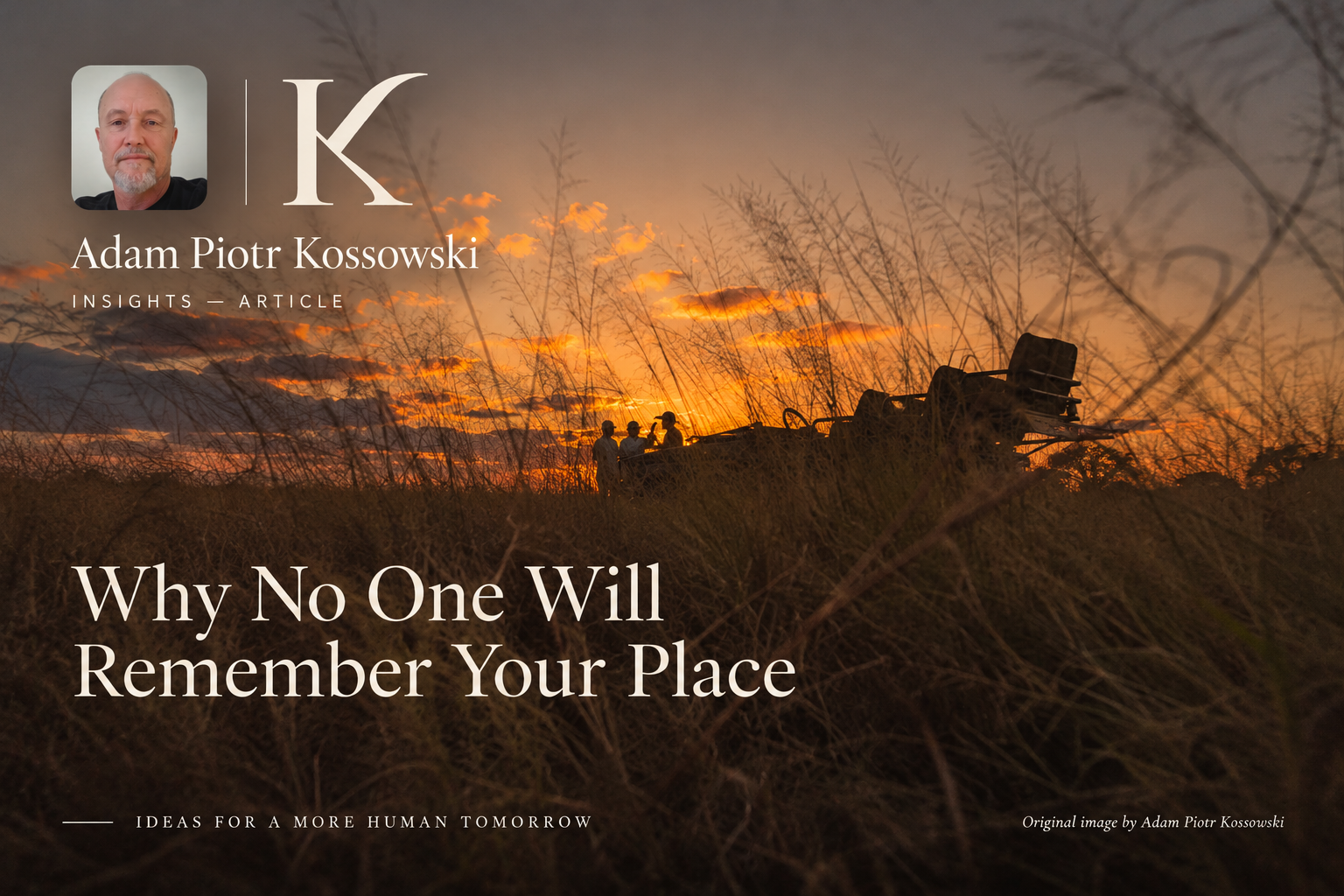
A game-viewing vehicle silhouetted against the evening sky. Photograph © Adam Piotr Kossowski.
You can spend years making a place worth visiting, then introduce it to the world with words that could belong to absolutely anyone. Your website promises “authentic experiences” in a “unique setting”, with “unforgettable memories” apparently assured. Somewhere between caring deeply about the place and trying to sell it, the things that make it worth choosing have disappeared from view.
Your returning guests may know what makes it special. But someone new comparing your lodge, hotel or guesthouse with three alternatives has not yet had that experience. Their decisions will ultimately be influenced by what you have chosen to show and tell them. A place may be memorable once visited, but its introduction gives a stranger very little to remember.
I find that a miserable trade. Think of what those words might be standing in for: an awkward old building someone refused to give up on, a particular view from a particular chair, or the care taken to make an almost impossible journey possible.
Consider Ximuwu, a safari lodge in Klaserie, in the Greater Kruger area. Its approach to accessibility grew out of co-founder Patrick Suverein’s experience of temporarily using a wheelchair after back complications. What began as a personal difficulty helped create a lodge designed to welcome others with similar needs. Condé Nast Traveler
The lodges’ published facilities include adapted game vehicles, wheelchair-friendly paths and a pool lift. For a potential guest who needs those facilities, a photograph of a pool tells only half the story. Knowing how they will get into it may be far more important than knowing how beautifully it catches the evening light. Ximuwu Lodge
This is a good example of where an owner’s story becomes useful to someone else. “Luxury in the African bush” leaves plenty to the imagination. But explaining how someone can join the game drive answers a question that might determine whether the holiday is possible at all. The care becomes visible in something the guest can actually use.
As a photographer, I honestly cannot put all the blame on the words. An empty terrace, a glowing pool and a perfect sunset are all lovely individually yet strangely anonymous together. My photograph of the game-viewing vehicle at sunset suggests the atmosphere of an evening in the bush. But it does not tell you which lodge would suit you, what a stay includes or why you should choose it over another.
In a different example in April 2023, Italy managed to advertise its charms with a scene filmed in Slovenia. A video in its €9 million “Open to Meraviglia” tourism campaign showed people enjoying wine on a sunny patio. Both the patio and the wine were Slovenian. Friends, sunshine, wine: the mood was right. But the country was wrong. ABC News
For me, this uncomfortable point goes beyond checking where the footage was shot. Once you reduce a place to just the familiar ingredients of a lovely holiday, somewhere else can start to look like a perfectly acceptable substitute.
Look at my photograph Arniston on Main. Whitewashed cottages sit beside an open village street, with warm light and a gull overhead. Crop tightly around a wall and you might have a handsome study of light and texture. Leave the street in, and the cottages have neighbours. They belong somewhere. My wider Arniston study is a personal photographic project, but the distinction for me matters here: showing the character of a destination is not yet giving someone a reason to choose a particular place to stay.
That next step is harder, particularly when an owner has poured years into a place. Imagine restoring an old house, then being told your website spends too much time explaining the restoration. It probably would feel like being told that your effort did not matter. Yet the person reading about your place may be planning the first weekend away with their partner in two years. They are bringing their own story. If your restoration created a sheltered courtyard where breakfast can become a whole morning, help them picture that. Give your history somewhere to meet their hopes.
Often the difficulty begins when “I love this” becomes “our guests must love it too”. A shared dinner might be part of a lodge’s appeal for someone who enjoys meeting other travellers, and exactly what another guest wants to avoid. I have personally experienced this and empathised with visitors at a game lodge who were clearly uncomfortable having to share a table every evening and take part in conversations they did not want to have. Both types of guest can appreciate a beautiful place; they are simply looking for different holidays. Trying to reassure everyone with the same promise tells neither very much. Rather consider the visitors interest through their eyes and consider and the options to be offered, than reflect your view of what another person should experience.
There is an awkward counterargument, though, to all of this. Disney’s Star Wars: Galactic Starcruiser opened in March 2022, offering a two-night adventure in which guests became part of the story. Packages started at about US$4,800 for two people, including accommodation, meals and admission to Hollywood Studios. Unfortunately, its final voyage ended on 30 September 2023. This was hardly a shortage of imagination or a forgettable idea. PR Newswire
Interestingly, that closure did not prove that marketing caused it, but it did challenge the comforting notion that an extraordinary story is enough. A guest still has to want the experience at the price being asked. A straightforward guesthouse does not need to invent an extraordinary history to justify a comfortable night and a genuinely warm welcome.
Before recommending more content, I would want to focus on what guests ask before booking, what returning visitors say they value, and how much of that is actually shown in the current presentation. If people can’t find what is included in the rate, another sunset photograph won’t answer them. If the team disagrees about whom the place is best suited to, a copywriter cannot solve that simply by finding more attractive words.
Those are different problems, requiring different decisions. Sometimes the value is already there but poorly explained. Sometimes the promise needs evidence. Sometimes the offer itself needs attention. I would rather first establish which of those we are dealing with before suggesting another website, video, or social campaign.
This is the work behind my Positioning & Message Review. I examine what you offer, whom it serves and what supports your claims, then bring the findings into a written positioning summary, a central message and practical recommendations your team can use. If your place seems better understood by those who have stayed than by those considering it, you are welcome to get in touch.
Unsure? Place your leading photograph beside your opening paragraph and finish this sentence: “This would be the right place for someone who … because …”. Use only what a stranger can actually see or read. If all you can offer is “someone who wants a wonderful holiday”, what have you given them to remember you by?