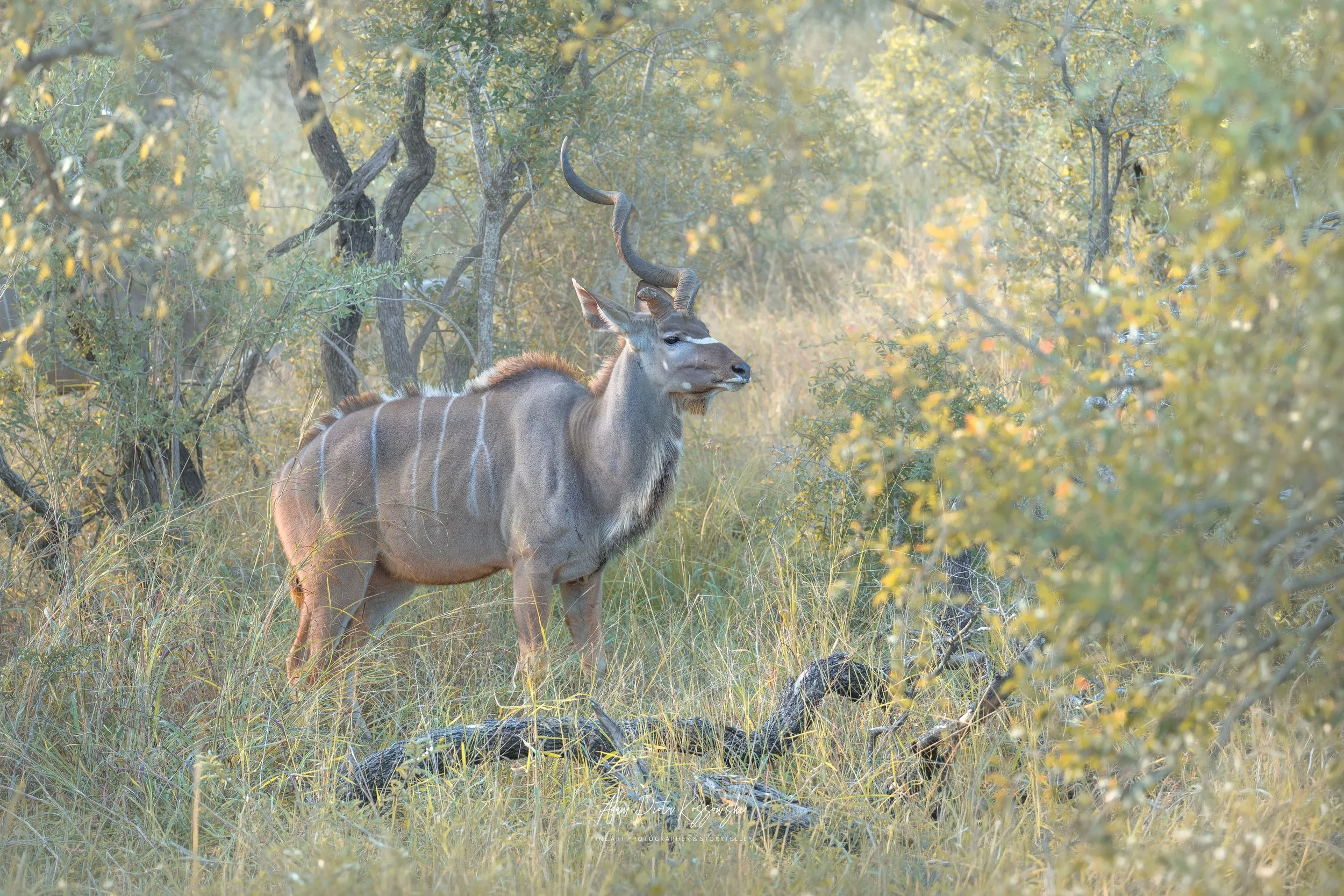
UNICORN - Greater kudu bull, Kruger National Park. © Adam Piotr Kossowski.
An extraordinary kudu, a missing horn, and a beautiful early-morning encounter in Kruger National Park.
There is something quite magical about those early mornings in Kruger National Park, when the bush is bathed in that glorious, gentle light and everything seems to glow with the soft, delicate colours of a new day. We were making our way back to camp, surrounded by a beautiful tapestry of pale golden grasses, silvery-green foliage and the warm, honey-coloured leaves catching the first rays of sunshine. The trees cast their long, delicate shadows across the woodland floor, while little pockets of sunlight danced amongst the branches, bringing an almost dreamlike quality to the landscape. It was one of those wonderfully peaceful mornings when I find myself simply enjoying the beauty of the bush, taking in its colours, textures and quiet atmosphere. And then, almost unexpectedly, there he was. Standing amongst the trees, partly concealed by the delicate tangle of branches and grasses, was a magnificent kudu bull. His lovely silvery-grey coat seemed to melt into the surrounding woodland, yet the moment I noticed him, I was completely captivated.
What a beautiful animal he was. Tall, elegant and wonderfully sculpted, with those enormous, expressive ears, a handsome, finely marked face and a powerful body decorated with the most delicate white stripes. A darker, almost chocolate-brown ridge of hair ran along his back, while the soft, shaggy hair beneath his throat caught the gentle morning light. I loved how the cool, almost powdery blue-grey tones of his coat contrasted so beautifully with the warm yellows, faded greens and golden highlights surrounding him. There was a wonderful softness to the entire scene, as though the woodland had been painted in delicate layers of colour. He stood almost motionless, but there was nothing relaxed about his expression. Those magnificent ears were alert, his eyes watchful, and I could sense that he was rather cautious of our presence. He seemed to be quietly studying us, perhaps deciding whether we were something to be concerned about. I found myself completely absorbed by him, his extraordinary beauty and the almost mythical quality of the scene. And then, as I looked a little more closely, I noticed something rather unusual.
He had only one horn.
Rising above his head was a single, magnificent spiral, gracefully twisting towards the sky. The other was missing, leaving him with a rather extraordinary appearance, almost as though he had stepped out of some ancient African fable. There was something both enchanting and slightly strange about it. Greater kudu bulls are renowned for their magnificent pair of spiralling horns, arguably amongst the most beautiful of any African antelope. Yet here was this impressive animal, standing quietly in the early-morning sunshine, with just one remaining.
Apparently, he had lost the other horn quite recently during a fight with another male. I hadn't witnessed the encounter, so I could only imagine what might have happened, but the thought of these two powerful animals confronting one another somewhere in the thick African bush was rather fascinating. Perhaps it had been a fierce contest over a female, or simply a challenge between two mature bulls establishing their dominance. Whatever the circumstances, this kudu appeared to have come away from the encounter with a permanent reminder of that particular morning or afternoon in the bush.
Greater kudus are amongst Africa's largest and most elegant antelopes, with mature males sometimes weighing well over 200 kilograms. Despite their rather gentle appearance, they are extraordinarily powerful animals. Their magnificent horns, which can grow to more than a metre in length when measured along the spiral, are used during contests between males, particularly when competing for breeding opportunities. During these encounters, bulls may lower their heads, interlock their horns and push against each other with considerable force, twisting and turning as they attempt to gain the upper hand.
It is quite remarkable to think that something so beautifully formed can also become such a formidable instrument of strength. These contests are usually resolved without serious injury, but occasionally the consequences can be severe. Horns may be damaged or broken, and in rare circumstances the spirals can become so tightly entangled that the animals are unable to free themselves. There have even been documented cases of kudu bulls becoming fatally trapped by their interlocking horns, a rather tragic consequence of the extraordinary structures that make these animals so recognisable.
Unlike the antlers of deer, which are shed and regrown, a kudu's horns are permanent. A broken horn will not simply grow back into its original magnificent spiral. Whatever had happened to this particular bull, it had left him with an unusual appearance that would likely remain with him for the rest of his life.
I found myself wondering about his story. Had he been the stronger of the two? Had he lost the contest and retreated into the bushveld? Was the missing horn the result of one particularly fierce encounter, or had it broken after years of smaller battles and challenges? There was no way of knowing, of course, and perhaps that was part of what made him so interesting to me. Every wild animal has a history that we can only begin to imagine, a collection of encounters, struggles and experiences that take place beyond our view.
Despite his missing horn, there was nothing particularly defeated about him. He stood proudly amongst the trees, his broad shoulders and muscular body giving him an unmistakable presence. His large ears moved attentively, and his beautiful dark eyes remained fixed in our direction. I had the impression that he was keeping a very careful watch on us, not entirely comfortable with our presence, yet not sufficiently concerned to disappear into the surrounding bush.
There was a lovely mixture of caution and curiosity in his behaviour. He seemed quite prepared to stand his ground for the moment, provided we kept our distance and allowed him the space he clearly wanted.
Kudus are naturally shy and cautious animals, and their ability to disappear into the surrounding vegetation is quite extraordinary. Even a fully grown bull, with its considerable size and impressive horns, can become almost invisible amongst the trees and branches of the African woodland. Their beautiful pale stripes, usually numbering between six and ten along each side of the body, help break up their outline against the vertical patterns of branches, grasses and shadows.
Those enormous ears are equally important. They are exceptionally sensitive to sounds, allowing the animal to detect movement and potential danger while remaining perfectly still. A kudu may stand quietly amongst the vegetation for some time, listening and assessing its surroundings before deciding whether to move away. And when it does decide to leave, it can do so with remarkable speed and agility, effortlessly negotiating dense bush and clearing obstacles that appear almost impossible for such a large animal.
They are principally browsers, feeding on leaves, tender shoots, flowers, seedpods and fruit, and are particularly well suited to the woodland and thicker bushveld of places such as Kruger. Mature bulls are often encountered alone or in small bachelor groups, while females and their young generally remain in separate herds.
There is something rather appealing about these solitary bulls. They often seem to inhabit the quieter, more secluded parts of the bush, moving almost silently through the woodland, occasionally emerging into the open before disappearing once again amongst the trees. I have always admired their elegance, their beautiful markings and the remarkable way in which they seem to belong so completely to their surroundings. And this particular kudu was no exception.
I particularly loved the contrast between the warm, golden vegetation and his lovely silvery coat. The subtle grey-blue and mauve tones of his body seemed to take on a life of their own against the surrounding yellows and greens. His fine white stripes followed the curves of his body, catching just enough light to remain visible without appearing harsh or overly defined.
Even the darker ridge of hair along his back added something special, its rich brown tones providing a gentle contrast to the softer colours of his coat. And above it all rose that magnificent single horn, its beautiful spiral standing out against the delicate confusion of branches and leaves.
The entire scene had an almost painterly quality. Nothing appeared particularly sharp or dramatic beyond the kudu himself. The surrounding vegetation seemed to dissolve into a soft tapestry of colour and texture, with the gentle morning light bringing everything together in a way that I found quite captivating.
I have always loved these quieter colours of the African bush. We often associate Africa with the intense golden light of sunset, the deep orange glow of the horizon or the dramatic contrasts of a landscape beneath a cloud-filled sky. Yet there is another beauty to be found in the softer moments, when the light is gentle, the colours are understated and the landscape seems to settle into a wonderful harmony of muted tones. It was precisely this quality that I wanted to capture in my photograph.
Rather than trying to isolate the kudu completely from his surroundings, I liked the way he belonged within them. The branches, grasses and softly illuminated foliage were as much a part of the image as the animal himself. They provided a natural frame, almost embracing him within the bush, while the slightly blurred vegetation in the foreground added a lovely sense of depth and intimacy.
There was no need for dramatic movement or an extraordinary display of behaviour. The beauty was simply in the moment itself, in the quiet presence of this unusual animal standing amongst the dense bush and thorny trees, surrounded by the delicate colours of an African morning.
And yet, beneath all this beauty, there is another story. Here stood a mature kudu bull, a magnificent creature that had clearly experienced something rather more dramatic than the peaceful scene unfolding before me. His missing horn was a visible reminder that life in the wild is not always as gentle as the photographs we bring home.
Wild animals live with a constant mixture of uncertainty, competition and danger. They must find food, remain alert to predators, defend themselves when necessary and, in the case of mature males, occasionally confront others of their own species. There are no guarantees that they will emerge from every encounter without injury, nor any certainty that the next challenge will be easier than the last.
We tend to admire the extraordinary beauty of wildlife, its strength, freedom and apparent independence, but it is easy to forget how demanding that co-existence can be. The quiet animal standing before us may have survived years of encounters that we will never know about, some ordinary and uneventful, others perhaps quite extraordinary. Perhaps it was the way he stood so cautiously, watching us with those lovely expressive eyes. Perhaps it was the softness of the morning light, or the extraordinary contrast between his powerful body and the delicate woodland surrounding him. Or perhaps it was simply the unusual beauty of an animal that had lost something so characteristic of its species, yet remained such an impressive and captivating creature. Whatever the reason, the encounter made an impression on me.
I decided to call the photograph Unicorn.
I often find that some of my most memorable wildlife photographs come from encounters such as this. Not necessarily from moments of great excitement or dramatic action, but from those quieter, unexpected meetings when something about an animal, its surroundings or the beautiful light makes me want to linger just a little longer.
It reminded me of another unexpected encounter in the Greater Kruger, when a solitary leopard appeared along a quiet bush track one misty morning. I later wrote about that experience in Last Patrol, another photograph that impressed me because of the unusual stillness of the moment and the feeling of having briefly crossed paths with an animal whose story I would never fully know.
Photographer's Note
Unicorn was photographed in Kruger National Park during an early-morning return to camp. The subject is a mature male greater kudu with one missing horn, apparently lost during a recent encounter with another bull.
The photograph speaks to the wonderful relationship between an animal and its surroundings. I loved the soft, almost powdery blue-grey tones of his coat against the warm golden leaves, delicate grasses and faded greens of the woodland. Rather than isolating the kudu from his natural surroundings, I wanted to preserve the gentle atmosphere of the morning, allowing the colours, light and textures to become part of his story.
For me, of course, the missing horn gave him an extraordinary appearance, but it was the combination of his unusual beauty, cautious expression and the delicate colours of the African bush that made this such a memorable encounter.