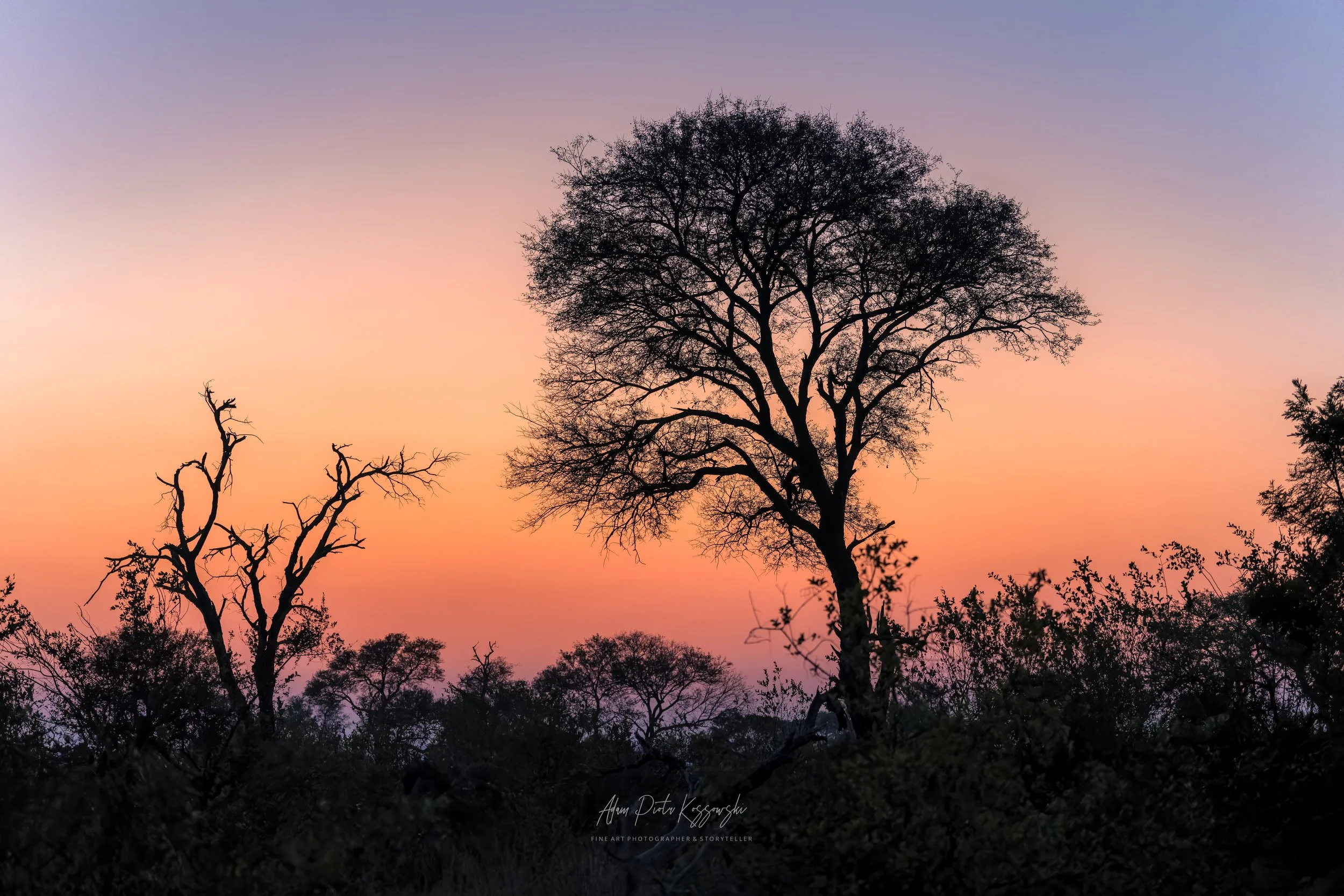
A magnificent tree silhouetted against the soft evening colours of Kruger National Park, South Africa. Original photograph © Adam Piotr Kossowski.
Beyond the wildlife, there is another side to Kruger National Park. A world of extraordinary landscapes, changing light and contemplative moments that can be just as memorable as the animals we travel there to see.
Whenever we talk about Kruger National Park, the conversation almost always turns to its wildlife. The excitement of seeing a leopard, a pride of lions resting beneath a tree, or a herd of elephants making their way across a dusty road creates many conversations afterwards. These are wonderful encounters, and I certainly never tire of them. But there is another side to Kruger that we often overlook in our enthusiasm to find the next animal, and one that I have come to appreciate just as much when I look back at my images. It is the extraordinary beauty of the place itself.
Travelling through Kruger is an experience, even when there are no animals in sight. The changing colours of the sky, the unusual shapes of old trees, the winding tracks and the endless variety of scenery all have their own appeal. Sometimes the landscape opens into enormous stretches of grassland, while at other times the bush closes in around you, with every bend in the road revealing something different, often surprising.
Some of my favourite photographs are not necessarily of wildlife at all. They are simply moments when the light, the colours and the landscape come together in a way that makes me want to stop, take out my camera and capture something of what I am seeing.
An ordinary tree, for instance, can become something quite magnificent against an evening sky. As the light fades, its intricate branches form beautiful silhouettes against soft shades of pink, purple and peach. I love the character of these old trees, particularly when they stand out against such extraordinary colours. There is a wonderful sense of peace about the scene too, although beneath those branches and in the surrounding bush, life carries on, much of it, of course, hidden from view.
The following morning can bring on an entirely different atmosphere. Mist settles over the water, drifting between the trees and turning the landscape into a mysterious mixture of soft greys and muted greens. Fallen branches emerge from the shallows, reflections appear and disappear in the haze, and the outlines of distant trees become almost ghostlike.
There is a beautiful stillness during this time, with the bush slowly emerging itself as the light improves and the chill of the morning air departs. You know there is wildlife somewhere among the trees and along the water's edge, but the landscape again grabs a bit of my attention at this time of day. It is really worth stopping simply to enjoy and soak in the atmosphere, rather than always searching for something moving in the distance.
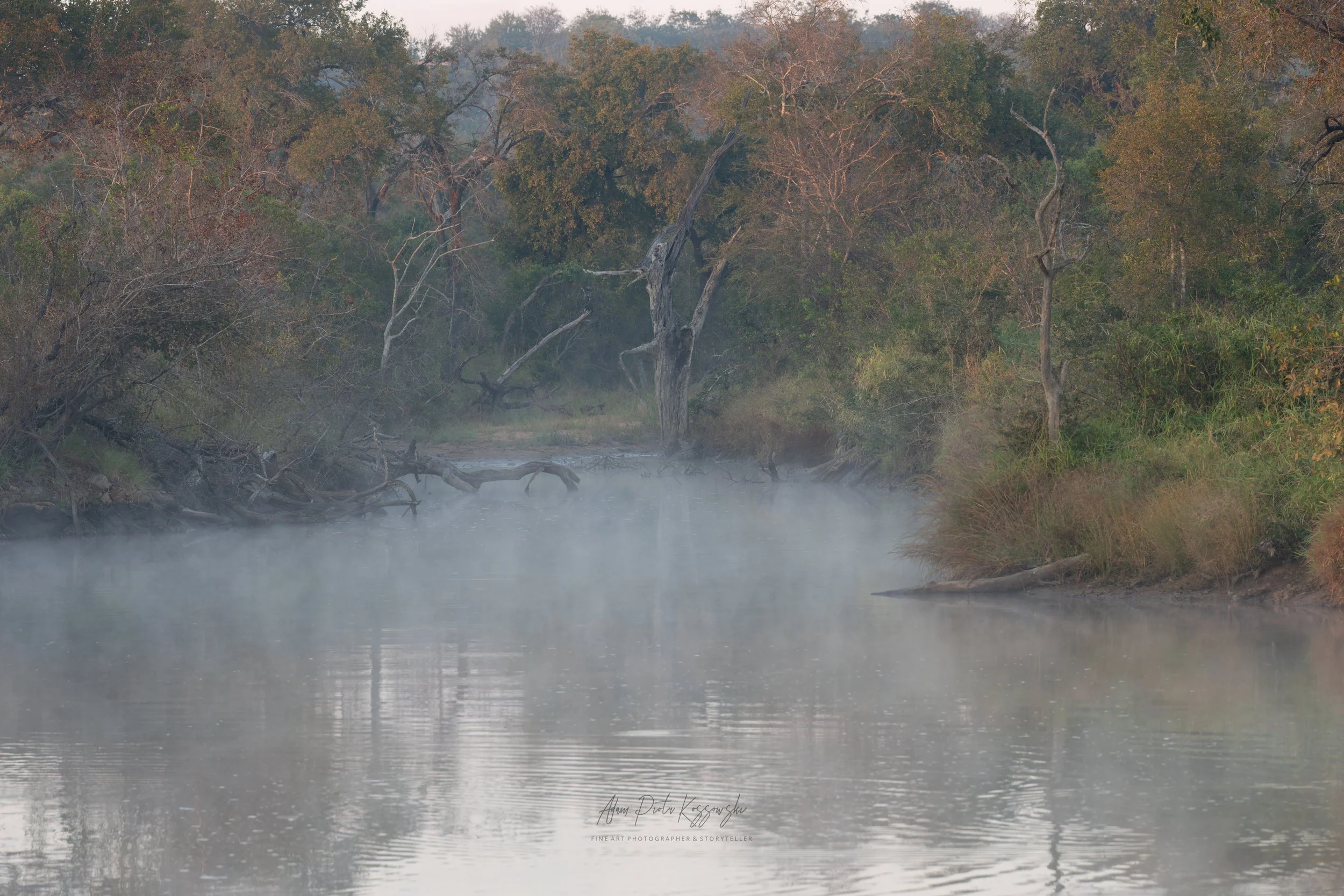
Early morning mist hangs over a quiet waterhole, softening the trees and their reflections into a peaceful, almost dreamlike landscape.
As the sun rises, everything begins to change again. The mist lifts, the shadows retreat and the landscape takes on beautiful shades of gold and amber. Water reflects the glowing sky, while the surrounding trees and vegetation slowly emerge from the morning haze.
A small pool of water can become a magnificent mirror, reflecting clouds that seem to glow from within. Even the dust suspended in the air adds warmth and depth to the scene, while the low sunlight catches the tops of trees and the edges of the surrounding bush.
These moments don't last very long, which is perhaps part of their appeal. The light changes almost continuously, and a scene that looks quite ordinary an hour later can be breathtaking in those first moments of the morning. So I find myself looking for these changes as much as I look for the animals, because the atmosphere can be just as memorable as the wildlife encounter itself.

Golden morning light reflects across the water as the rising sun brings warmth and colour to the surrounding bush.
One of the things that makes Kruger so fascinating is the enormous variety of landscapes found within the park. Stretching approximately 350 kilometres from north to south and covering almost two million hectares, it is far from being one continuous stretch of bushveld.
In fact, SANParks identifies sixteen broad ecological zones within Kruger, each with its own combination of vegetation and environmental conditions. The northern parts are dominated by mopane veld, while further south the scenery changes considerably, with different woodlands, open grasslands and riverine vegetation. The official SANParks guide to Kruger's vegetation provides an interesting account of this remarkable diversity.
You begin to appreciate these differences as you travel through the park. Sometimes the changes are subtle, with slightly different trees or grasses appearing along the roadside. At other times, the landscape seems to open up completely, revealing rocky hills, broad grassy plains or dense stretches of woodland that feel quite different from the area you have just left behind.
I particularly like the quieter tracks that wind their way through the bush, where an old, weathered tree stands beside the road and the landscape disappears into the distance. Its twisted branches and rough, ageing trunk have a character of their own, made even more beautiful when the warm sunlight catches the surrounding vegetation.
There may be no animals in sight, but the road draws your eye into the landscape, leaving you wondering what lies beyond the next bend. These are the scenes that make travelling through Kruger such a pleasure, even on days when the wildlife seems determined to remain hidden.
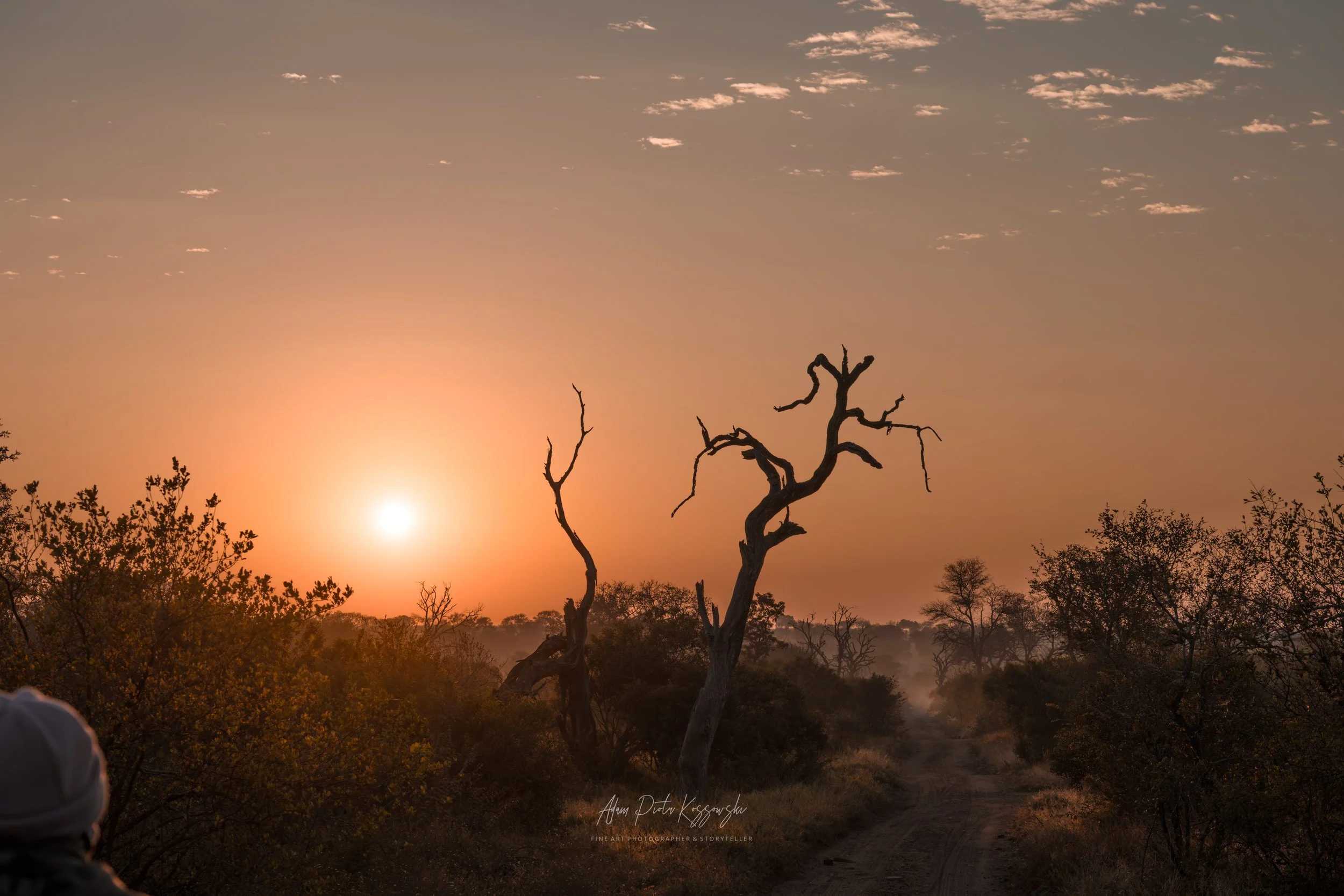
A winding track disappears into the bush beside an old, weathered tree, capturing the quiet beauty of travelling through Kruger.
Even the ground beneath our feet plays a part in what we see. Much of Kruger lies on two very different types of rock, granite and basalt, which have helped create the character of the landscapes above them. The more fertile basalt soils generally support open grassy areas, while the granite regions often have denser woody vegetation.
It is rather fascinating to think that something as simple as the rock beneath the surface can have such an influence on the appearance of the bush. Add the effects of rainfall, fire and the changing seasons, and you begin to understand why Kruger's scenery varies so much from one area to another.
And Kruger is certainly not always green and lush. During the dry season, the colours fade, waterholes shrink and the earth can become hard and deeply cracked beneath the African sun. The surrounding vegetation takes on a dusty, weathered appearance, and the landscape can seem quite harsh compared with the lush greens that follow the summer rains. Yet there is beauty here too, although it is a very different kind.
One of my photographs shows an expanse of deeply cracked earth stretching towards a small group of people and a safari vehicle in the distance. The patterns in the dried mud almost look like an enormous mosaic, while the people appear tiny against the surrounding landscape. I love the contrast in this photograph, particularly the sense of scale it creates, but it also reminds me how much life in Kruger depends on the seasons and the availability of water.

Deeply cracked earth dominates the foreground while people and a safari vehicle in the distance provide a sense of scale in Kruger's dry landscape.
I think these scenes are important because they remind us that the beauty of Kruger isn't always found in its prettiest moments. There is character in the dry earth, the weathered trees and the dusty landscapes, just as there is beauty in the lush vegetation and flowing rivers after good rains. Each season brings its own colours and challenges, and together they make up the natural character of the park.
People also have their place in this wider picture, although my photography is generally more concerned with the wildlife and natural surroundings. In particular, I have always appreciated the guides, rangers and others who spend their working lives in and around Kruger, helping visitors discover and understand the extraordinary environment they are travelling through. Their knowledge of the landscape, the behaviour of animals and the subtle changes taking place throughout the year can add enormously to the experience.
The interplay between man and landscape can perhaps be seen in this image of a safari vehicle partly hidden behind tall grass and silhouetted against the evening light - another typical scene that appeals to me. It is a simple picture, but it says something about the journeys we make through Kruger and how small we really are within these vast natural surroundings.
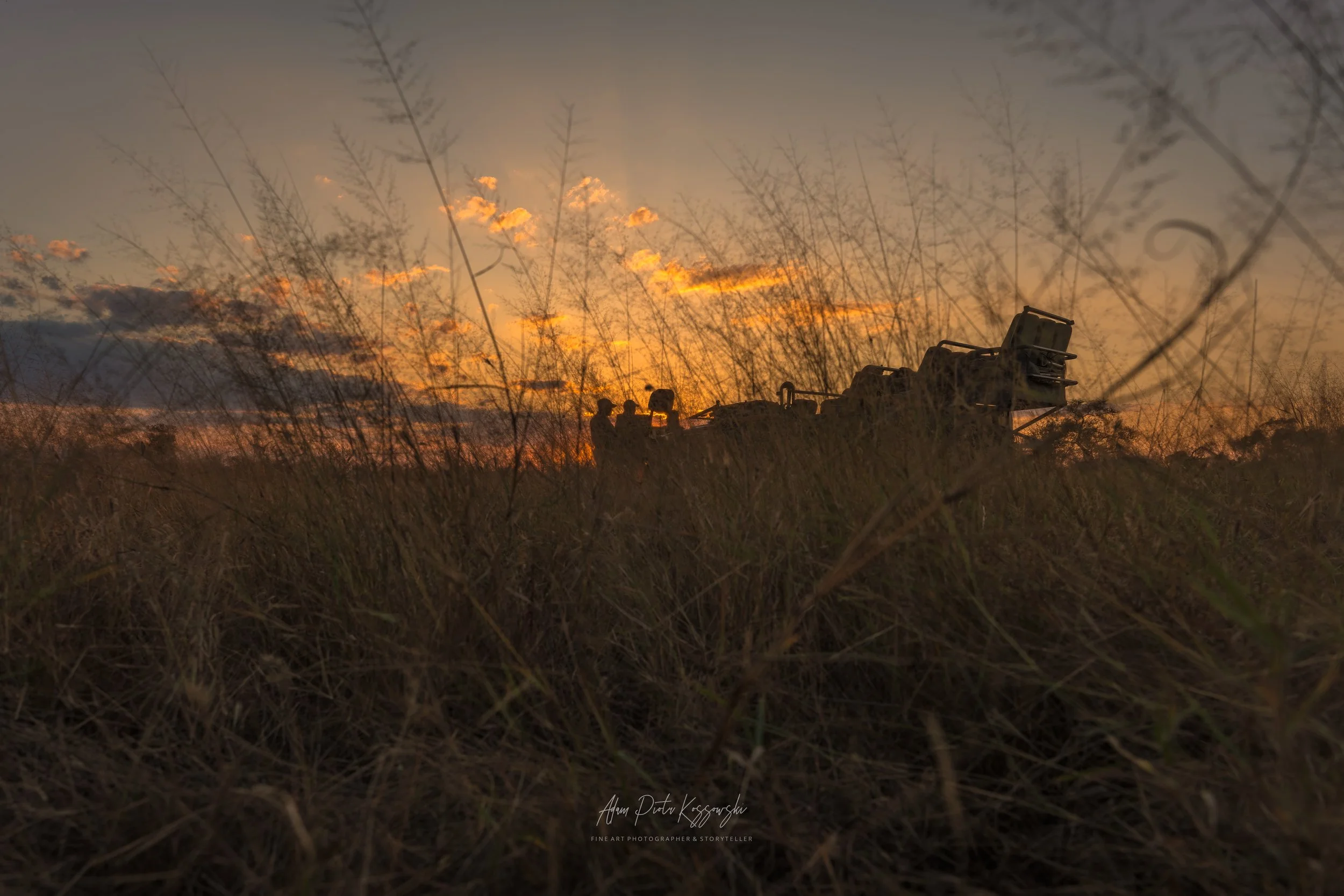
A safari vehicle silhouetted among the grasses and trees, a quiet reminder of the people who travel through and experience Kruger's vast landscapes.
As the day draws to a close, the atmosphere changes once again, and this is often when I find Kruger's landscapes at their most beautiful.
The last light of an African evening can be quite extraordinary. The sky moves through shades of gold, orange, red and purple as the sun sinks towards the horizon. Trees become dark silhouettes, the distant bush fades into shadow, and familiar scenes take on a completely different character.
I love photographing birds against these evening skies, particularly when they are perched high in the branches of an old tree. A solitary bird silhouetted against the setting sun can make a wonderful picture, but it is the combination of the bird, the tree and the surrounding light that gives the scene its real beauty.
In one photograph, a bird stands dead still among the upper branches of a dead tree, with the setting sun glowing behind an intricate tangle of old limbs. The branches spread across the sky in all directions, creating a wonderful natural frame around the sun and the bird. For me, the bird is only one small part of the picture. The tree, the sun and the darker bush beyond are just as important, and together they create a scene that is far more interesting than any one element on its own.

A solitary bird perched among the branches of an old tree as the setting sun illuminates the evening sky.
It is something I also explored in Nata, a photograph of a leopard silhouetted among the branches of a tree. Although the leopard is the obvious subject, the shape of the tree and the surrounding light are just as important to the photograph. Without them, the image would lose much of its atmosphere and character.
Yet sometimes, the landscape needs even less detail to make an impression. Another photograph that I particularly enjoy shows a bird gliding across an enormous orange sky above a dark line of trees. Below, the water catches the last light of the day, its rippled surface reflecting beautiful shades of red and gold. There is a wonderful warmth to this scene, and I love the simplicity of it. The bird adds a little movement and life, but it is the sheer expanse of colour in the sky and the reflections on the water that make the photograph memorable.
It is also a reminder that we don't always need to fill the frame with our subject. Sometimes the space around it is equally important, perhaps even more so, because it gives the photograph its atmosphere and a real sense of place.

A bird glides across the glowing evening sky above the warm orange and red reflections on the water in Kruger National Park.
Looking through these photographs, taken in different parts of Kruger, I am continuously reminded how much beauty lies beyond the wildlife we usually associate with the park. Every tree, waterhole, stretch of grassland and winding track has its own character, and the changing light can make even familiar places look completely different.
of course, there are so many smaller stories within these landscapes too. An old tree may have stood for decades, providing shelter and resting places for countless animals and birds. A dry waterhole may fill again with the summer rains, bringing new life to an area that seemed almost deserted only weeks before. Even an ordinary patch of bush can contain an extraordinary variety of plants, insects, birds and other creatures that we might never notice from the road.
And that, for me, is one of the great pleasures of photographing Kruger. The more you look, the more you begin to appreciate how much there is to see, and how easily some of its beauty can pass unnoticed.
I will always enjoy the excitement of a wonderful wildlife sighting, and I suspect most people visiting Kruger feel the same way. But some of my favourite photographs have very little wildlife in them at all. They are simply moments when the light, the landscape and the atmosphere come together in a way that makes me want to stop, look a little longer and remember what I am seeing.
So, the next time you find yourself travelling through Kruger, perhaps spend a little more time looking at everything around you rather than concentrating only on the animals you hope to find. Take in the trees, the colours, the tracks, the water and the changing skies. There is so much beauty in the wider picture, and sometimes the background we barely notice turns out to be the most memorable part of all. After all, Kruger is not only about the animals that live there. It is also about the magnificent place they call home.
All photographs taken in Kruger National Park, South Africa. Original photography © Adam Piotr Kossowski.