Who Has the Right to Tell the Story of a Place?
The story of a place rarely belongs to one organisation or one point of view. The more that story is influenced by what someone wants to sell, promote or protect, the more important it becomes to look at the other people, histories and experiences that make the place what it is.
A few years ago, I visited a wildlife destination near Cape Town that was marketed very strongly as a “game reserve”. I had a certain impression and, with that, expectation of what I was going to experience, particularly because I have been lucky enough to spend a lot of time in game reserves elsewhere in Southern Africa.
Once I was there, my impression of the location unfortunately changed quite quickly. There were wild animals, some conservation work and opportunities for visitors to view animals normally found in the wild. There was also a strong family and leisure side to the development, and some of the wildlife was managed in separate areas. What I encountered was disappointment - that the story used to promote it did not match the promise of what I would actually see and experience particularly well. The promise was a “Big 5 game safari experience” but I got was a hotel with encampments of some select species - a kind of a living zoo. If there was a better message to share, it would be that this location gave people close to the city an opportunity to view certain wildlife they would never normally see, learn something about conservation and spend time in a semi-natural environment that they would not normally experience. That would still have been attractive, honest, and it would have fulfilled my expectations far better.
It made me think about so many other “destination” or “place” presentations advertised where this same mis-match exists. Central to this line of advertising is who decided what a place is, which parts of it mattered most, and what story would the visitor be given before arriving?
A place can mean several things at once
Tourism needs places to explain themselves. If someone is considering visiting a destination, reserve, lodge, village or heritage site, they need to understand what is there and why it may be worth their time and expense to visit. The difficulty for many organisations though is that the story used to promote a place is usually only one view of it.
A tourism business looks at a destination through the visitor experience and what will attract people. A conservation organisation may focus on wildlife, habitat and environmental issues. Someone who lives there may see home, employment, family and the normal challenges of everyday life. A historian may describe what happened there many years ago, while a business owner is probably thinking much more about what needs to happen next. None of these views is necessarily wrong. It’s just that they simply have different priorities. So the problem starts when one of them becomes the final story that represents the place as a whole.
Research into destination branding has found much the same thing. Residents usually hold a more complex understanding of a place than the simplified version presented to visitors, and studies increasingly argue that their own stories should form part of how destination identity is represented.
What is destination storytelling?
For me, destination storytelling is how a place decides what visitors should understand about it before they arrive, and how that impression develops once they are there. It can draw on history, people, environment, culture and experience, but the important part is deciding which of those elements deserves the greatest attention and who gets to make that decision.
How tourism objectives influence the story of a place
I don’t believe organisations intentionally try to present a place inaccurately. Usually they focus on the parts that support what they are trying to achieve. Typically, a tourism authority wants more visitors, a lodge wants bookings, the conservation organisation needs funding and support, a municipality seeks investment, while a heritage organisation would be likely trying to protect a particular history. Each of these objectives therefore (and naturally) influences the story being told.
Certain attractions, histories and images consequently receive more attention because they are easier to communicate and more likely to support the objective of that organisation. Other parts of the place may be equally real, but they simply receive less attention because they are not as useful to the immediate message and priority of that organisation. Over time, this results in a destination becoming known through the same few and often repeated stories and ignores other opportunities that could help shape stories that are refreshing and often happening around them.
I found this in St Helena as well. The island has an extraordinary amount of history, culture, landscape and human experience, yet the same recognisable attractions tend to appear repeatedly when it is marketed to visitors. There are a lot, they are important, but they do not represent everything that St Helena is.
For me, the issue is less about finding more stories and more about deciding which stories matter, how they fit together and whether the stories being promoted still reflect the place properly.
A story can quickly become dated
I also think places change much faster than the story being used to market them.
A particular identity may have worked extremely well for many years, so it continues to be used - after all, it worked. Meanwhile, the community changes, the environment changes, businesses develop and what visitors care about changes too. But that is ignored. In this day and age, people may pay far more attention to conservation, sustainability, local livelihoods, community involvement and the impact tourism has on the places they visit. Those issues do not replace the older history or attractions, but they can change which aspects of a place people find relevant.
St Helena is a good example. Among its many attractions, visitors are offered the opportunity to swim with whale sharks. That alone is unusual, but there is a much bigger story around why the experience matters. St Helena attracts mature male and female whale sharks in unusually balanced numbers, and researchers believe the island may play an important role in their reproductive cycle. (St Helena Government)
For me, that changes the experience completely. It is no longer simply an activity where visitors can swim with whale sharks. It becomes an opportunity to see these animals in a place that may be important to the future of the species itself. The research and conservation material explains that significance very well. My question is whether enough of that story reaches the visitor at the point where the experience is actually being promoted.
I make the same choices as a photographer
I also need to recognise that I do much the same thing when I photograph something.
Every photograph is influenced by decisions I make. I decide where to stand, which lens to use, how close I want to be, what should remain inside the frame and what I want to leave outside it. I then make further choices when I edit the photograph.
My elephant portrait Ivory II is a good example. I photographed it very tightly around the eye, tusk and face. For me, there is something vulnerable and slightly sad in the expression, and that became part of how I later treated the photograph. The elephant was there and the moment was real, but the impression created by the final image was influenced by the choices I made.
I could have photographed the same elephant walking through a wide landscape or moving with the herd. The impression might then have been one of strength, movement, size or family. Both photographs could be truthful, but they would lead the viewer towards quite different interpretations.
I find that important because photography is often treated as though it simply records what happened. It does not. The photographer has already decided which part of what happened you are going to see.
Sometimes the story simply needs to be noticed
There are other moments where I feel less need to interpret because something interesting is already taking place.
I recently worked on a photograph of oxpeckers around a buffalo wound. One of the birds had removed part of the scab and was feeding from the blood while other birds were nearby. I found the behaviour fascinating because very little needed to be added to it. The story was already happening. My intention in that situation was to notice it, photograph it and understand enough about the behaviour to describe what I had seen correctly.
I think there is something useful in that when thinking about places too. Sometimes organisations decide too quickly what the story should be when there may already be a much more interesting one happening in front of them. This requires more observation and less presentation.
Arniston tells several stories
Arniston is another place where I have found several different versions sitting alongside each other.
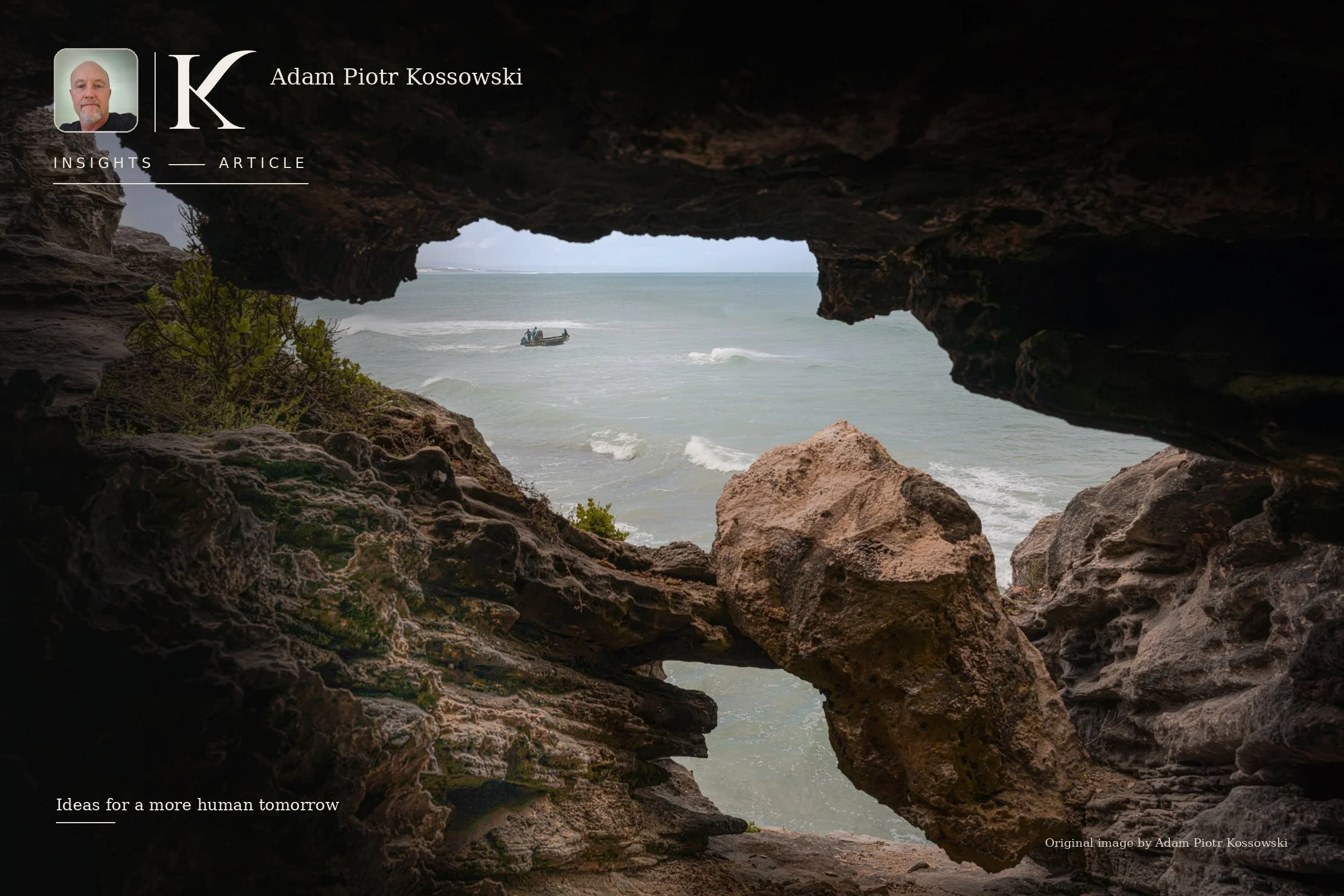
There is the coastline and the beauty that attracts visitors. There is Kassiesbaai and its historic fishing community. There are people whose livelihoods still depend on the sea. There is tourism, heritage, property development and the everyday lives of people who do not experience Arniston primarily as a holiday destination. The photograph we chose for this article looks through a rock opening towards fishermen on the water. It immediately gives one particular impression of the place.
Elsewhere in Arniston I have photographed whitewashed homes, windows, boats, streets and some of the smaller details around Kassiesbaai. Those photographs create a very different impression, even though they come from the same place. Neither version is more real or honest than the other, as the coastline is part of Arniston. The fishing community is part of Arniston. Tourism has an important role, but it is not the only thing happening there.
What I found interesting was how easily one of those versions could become the public image of the place, while the others became much less visible.
Looking beyond what is being promoted
If I photograph or write about a place, I think there is a responsibility to look beyond the first version being presented. This means spending time observing how the place actually works, understanding something about its history and, where possible, speaking to people who live or work there. Often the smaller things that would never appear in a tourism campaign tell you far more about the character of a place, which in turn can draw on the curiosity of the potential visitor. But I still have to accept that what I see is only my interpretation.
Someone who has lived there for forty years will understand things I cannot know as a visitor. A fisherman will see the sea very differently from me. Another photographer could stand beside me and make a completely different photograph. So I don’t think this means visitors or outsiders should stop telling stories about places. It simply means we should understand that we are offering a view of the place rather than claiming to represent the whole of it.
Who should be part of the story?
The challenge here is that I am not sure there is one person or organisation that has the complete right to tell the story of a place. People who live in a location clearly need to be part of it. Businesses, historians, conservationists, tourism organisations and visitors may each understand other parts that are worth hearing.
For me, the more useful question is whether enough of those views have been considered before one version is promoted as the identity of the whole place. And there is also a commercial reason to do this. The less obvious stories are often the ones that make a place genuinely different. In the case of Arniston, the most powerful story may be connected to a fisherman, a guide, an old building, a local tradition, a working harbour or something people living there walk past every day because it has become completely normal to them.
Those details often tell us so much more about a place than another description and photographic record of its beautiful scenery.
Keeping the story alive
Finally, for me it remains important to understand that a place continues changing regardless of how it has been marketed in the past. Communities develop, landscapes change, businesses come and go and new issues become important. Any story that represented a place ten or twenty years ago may still have value, but it may no longer be enough on its own.
For me, keeping a story alive means continuing to look at what is actually happening, who is part of it and what may have changed since the last time someone decided how the place should be presented. The aim should not be to find one final version of the story and keep repeating it. It should be to understand the place well enough to recognise when the story itself has moved on and set out a new narrative that talks to all of us .
Sources & Further Reading
Zenker, S., Braun, E. & Petersen, S. (2017). Branding the Destination Versus the Place: The Effects of Brand Complexity and Identification for Residents and Visitors. Tourism Management, 58, 15–27. DOI
Hay, N.A., Chien, P.M. & Ruhanen, L. (2022). Tell Me Your Story: Branding Destinations Through Residents’ (Place) Stories. Journal of Vacation Marketing, 28(3), 319–334. Sage Journals
Hakala, U. (2021). The Voice of Dwellers – Developing a Place Brand by Listening to Its Residents. Journal of Place Management and Development, 14(3), 277–300. Emerald Publishing
Perry, C.T. et al. (2020). St. Helena: An Important Reproductive Habitat for Whale Sharks (Rhincodon typus) in the Central South Atlantic. Frontiers in Marine Science, 7, 576343. Frontiers