First Spring
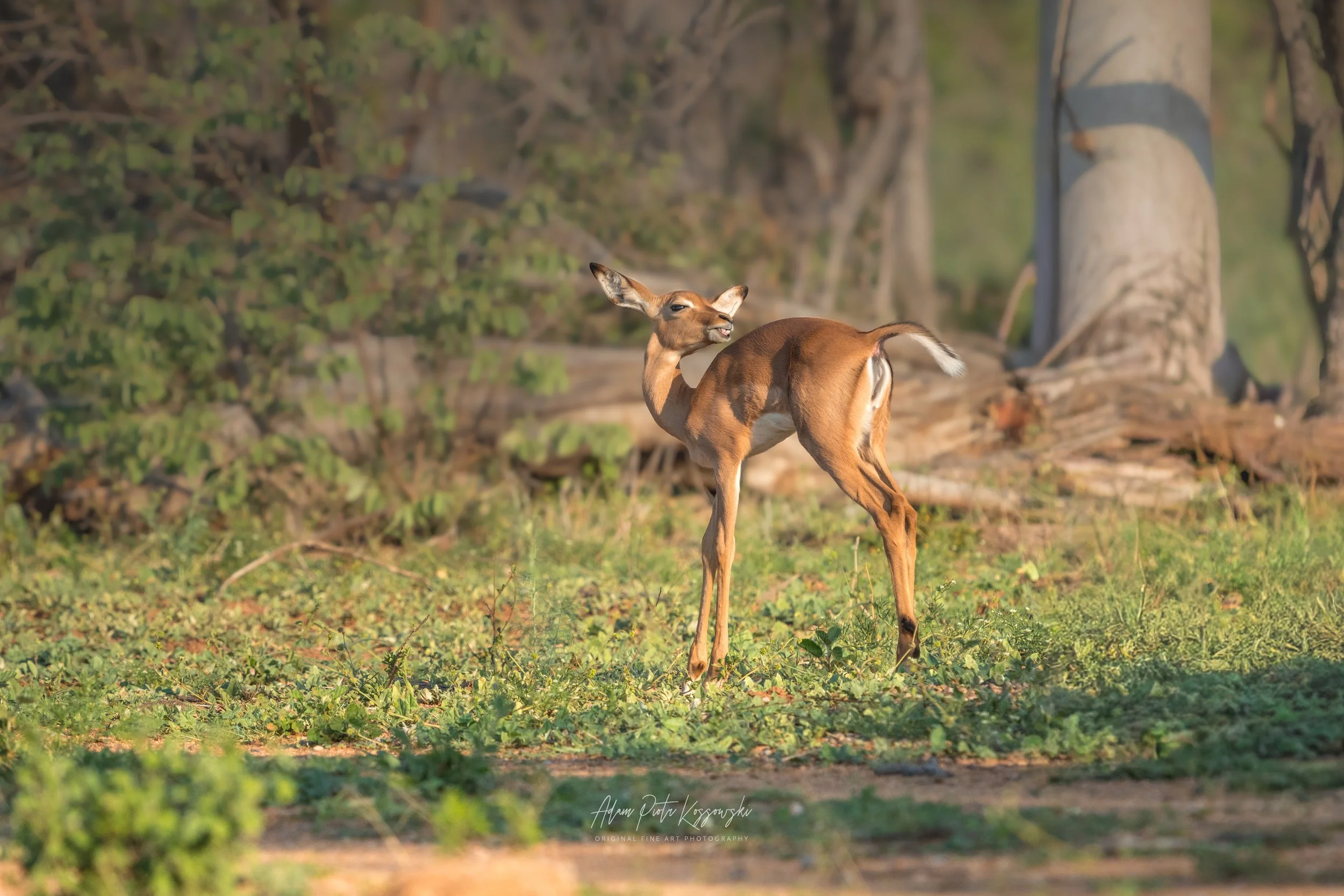
A young impala tests the world on new legs, caught between instinct and joy.
Late afternoon settles gently over the bush, the kind of light that softens everything it touches. Greens deepen, dust turns golden, and the air hums with sound. Insects stitch their presence into the stillness, a constant shimmer of life you feel more than hear. Somewhere nearby, a herd of impala feeds quietly, heads down, ears flicking, alert but untroubled. And then there is this moment.
He stands slightly apart, not far, but just enough. Still very young, his frame all angles and promise. Legs too long for certainty. Balance learned but not yet trusted. When he turns, it is quick and unguarded, a sudden twist of the body as if surprised by himself. His mouth opens just a little, teeth catching the light, an expression that feels less like alarm and more like delight. A fly has landed, or perhaps several. He bucks lightly, not in fear, but in irritation that borders on play.
This is what first spring looks like in the bush.
Impala are born into a world that demands vigilance from the very beginning. Within minutes of birth, a lamb must stand. Within days, it must run. Predators, such as the king of the night - the lion, do not wait for confidence to arrive. Yet there are moments, fleeting and precious, when survival loosens its grip and something softer slips through. Curiosity. Energy. The urge to move simply because the body can.
The herd nearby offers quiet assurance. Mothers graze. Others pause to watch. The youngster’s antics barely register as concern. His movement is loose, spontaneous, the way young animals often test their limits. A small leap. A turn. A shake of the back to dislodge buzzing irritants that seem far too interested in this new warmth and motion. Insects rise and fall around him, part of the same late afternoon chorus that fills the thornveld.
Impala are known for their agility and speed, but those abilities are not born fully formed. They are learned through repetition, through moments like this one. A twist here. A startled hop there. Each movement builds muscle memory that will one day matter when the stakes are higher. For now, it is enough to feel the ground beneath his hooves and the air sliding over his coat.
I watched from a respectful distance, camera steady, letting the scene unfold without interruption. At 524mm, the frame compressed the space just enough to isolate him from the herd, not to separate him from safety, but to tell his story. The Sony A1 froze the motion cleanly at 1/2000s, every line sharp, every flick of muscle clear. F8 held the depth just right, keeping the young buck crisp against the softened background of trees and fallen trunks. ISO 1000 carried the warmth of the fading light without stealing its mood.
Kruger’s Thornybush area has a way of revealing these quieter narratives. Not the drama of pursuit or the tension of confrontation, but the subtle poetry of life continuing as it always has. Feeding. Growing. Testing boundaries. The bush was alive with sound that afternoon, yet this moment felt strangely hushed, as if time itself had paused to watch.
Youth in the wild does not linger. It passes quickly, shaped by necessity and sharpened by experience. But for a heartbeat, sometimes for no longer than it takes to press a shutter, it reveals itself exactly like this. Unpolished. Joyful. Full of promise.
When he finally settles, the herd closes ranks again, and the rhythm of feeding resumes. The insects continue their work. The light dips lower. And the memory of that turn, that brief expression of exuberance, stays with you long after the bush grows quiet.
Photographer’s Note
This photograph was taken in the late afternoon in the Thornybush area of Kruger National Park. The image is a single authentic frame, captured while observing a nearby impala herd from a stationary position. Shot on a Sony A1 with the FE 200–600mm F5.6–6.3 G lens at 524mm, 1/2000s, F8, ISO 1000. The intention was to isolate a fleeting moment of youthful movement and expression without disturbing the animals, allowing the natural behaviour to unfold.
About The Raw Africa Collection
The Raw Africa Collection is a series of fine art wildlife photographs capturing the untamed beauty, power, and diversity of Africa’s animal kingdom. Each image tells a story — moments of stillness, bursts of movement, and the raw essence of life in the wild.