Pink Moon
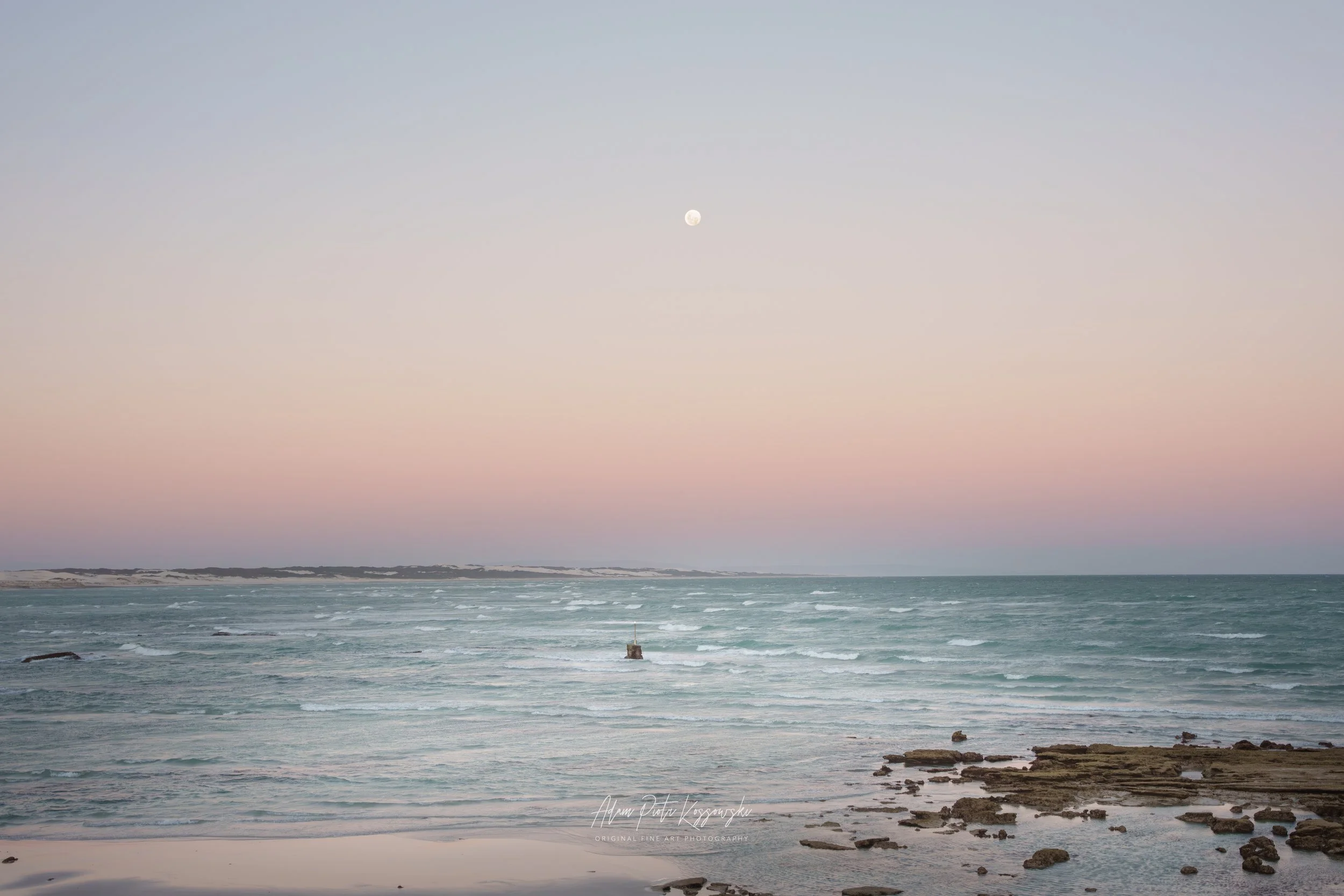
A brief blush over wild shores
The sun had already gone when the colour arrived.
Along the Arniston coast, the finest light often waits until people think the evening is over. The obvious glow fades. The beach empties. The sky flattens into something undecided. And then, in the narrow space between day and night, the horizon shifts.
I had walked down past the harbour at Kassiesbaai, keeping to the right where the reef lies low and open to the Atlantic. The small beacon stood near the harbour entrance, fixed and purposeful, guiding fishing boats home through shifting sandbanks and uncertain light. It has watched countless returns at dusk. That evening, it stood in silhouette against a horizon about to change.
At first the sky was pale and drained. Then a faint warmth began to gather along the far western edge of the sea. Not the blaze of sunset, that had already passed, but something subtler. A thin seam of colour suspended between the cooling blue above and the darkening Atlantic below.
It deepened slowly into a pink champagne hue, soft and luminous, as though the air itself had been gently tinted. The band stretched along the horizon and carried eastward, following the distant line of the Southern Cape coastline as it runs toward Cape Agulhas. From where I stood, the land flattened into a low silhouette, barely distinct from sea and sky, yet anchoring the scene in geography and distance.
These moments remind me of other quiet transformations along this shore, such as the changing light described in Off Shore, when the Atlantic quietly reshapes colour and mood without warning.
The Atlantic responded in fragments. The upper edges of the swells lifted the blush and carried it forward before folding back into steel blue. In the shallow pools trapped within the reef, the champagne tint flickered and trembled, breaking apart with each small ripple. The beacon rose dark against the glowing band, briefly edged in warmth before settling back into shadow.
You could feel how short-lived it would be.
The air cooled perceptibly. The warmth of the December day loosened its hold. The dunes across the bay thinned into silhouette. The low percussion of water against rock seemed more pronounced once the colour gathered, as if sound sharpens when light softens.
For perhaps five minutes, the entire western horizon carried that gentle blush.
It was not dramatic. It did not flare or shout for attention. It asked for timelessness in a moment.
The beacon remained steady, a marker of return and livelihood, while the pink champagne light belonged only to that brief atmospheric pause. Fishing boats would navigate by the beacon long after the colour drained from the sky. But this interval, this delicate seam between warmth and twilight, was its own quiet event.
Then it began to thin.
Blue pressed downward from above. The champagne hue softened to rose, then to faint coral, then to memory. The Atlantic darkened. The reef lost its reflective sheen and returned to textured shadow. The beacon, once outlined against warmth, stood against the onset of night.
The interval closed without ceremony.
What remains is the awareness of it; that along Arniston’s wild shores, beauty often arrives after the show. That it lingers briefly along the edge of the Southern Cape, tracing the distant coastline toward Cape Agulhas, the southernmost tip of Africa, before surrendering to blue.
By the time I turned back toward the hotel, the first lights had begun to glow inside. The harbour lay quiet. Just a twinkling of residential lights and the Atlantic continued its measured rise and fall.
The horizon had returned to night.
Photographer’s Note
Captured in December in Arniston, Western Cape, from the shoreline to the right of Kassiesbaai harbour during the brief after sunset interval when a narrow band of pink champagne forms between the fading sun and twilight. The beacon offshore guides fishing boats into the small harbour. Single exposure on Sony A1, Sigma 24–70mm at 43mm, 1/160s, f/9, ISO 1250. No compositing. The colours reflect natural coastal light lasting only a few minutes.