Elder In Black
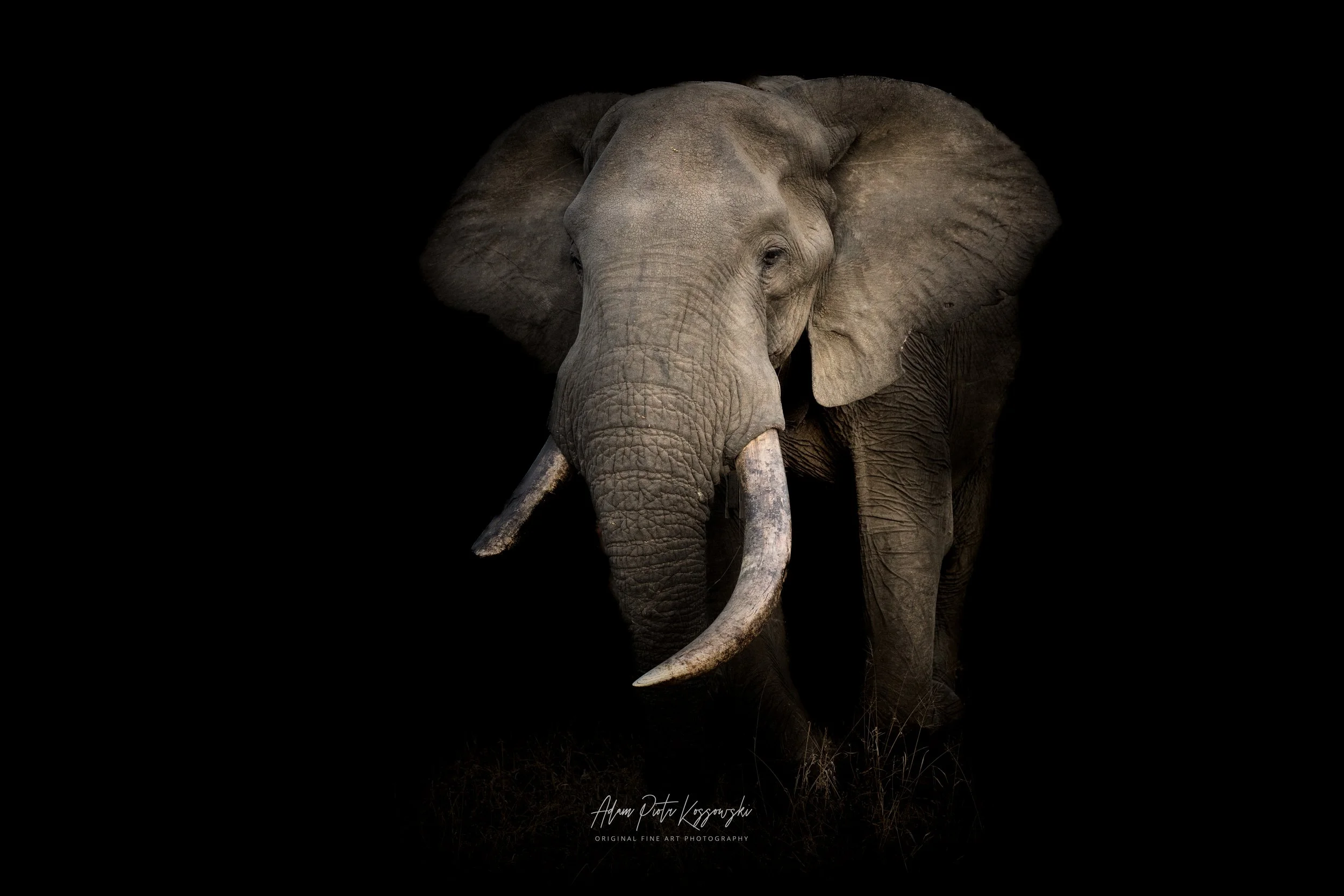
A giant steps out of darkness, and the bush seems to hold its breath.
He arrives the way a storm arrives, not with speed, but with certainty, and for a moment the night feels as if it has been waiting for him. The world around him is almost entirely black, not the soft black of dusk but something deeper, like a curtain drawn across the bush, and then the curtain parts just enough to reveal the curve of an ear, the broad dome of his head, and the pale sweep of ivory that catches the last available light as if it is remembering the sun. This is the same bull from The Elder, the same old tusker with the calm, deliberate way of moving that makes time slow down around him, but here the atmosphere is different. In the earlier scene, dust and morning light made him feel like a relic walking through open air. In this one, the darkness does the opposite. It removes everything else until only he remains, and suddenly you are not looking at a landscape at all, you are looking at presence.
When a bull elephant reaches this age and carries ivory like this, he becomes something more than a passing animal in the distance. Older bulls are the great solo travellers of the savannah, often moving alone or with one or two companions, reading the country as if it is written in a language only they fully understand. Their days are measured by water and shade and the slow economy of feeding, and they have a way of appearing exactly where you would not expect, stepping out of thicket or mopane shadow with an ease that seems impossible for something so immense. It is worth remembering that an elephant’s sense of smell is extraordinary, and far more important to him than his eyesight, so long before you see him he has already tasted the wind and mapped you in his mind, not as a face but as a signature of breath, skin, fuel, dust, and whatever the day has carried to you. That is part of what makes his calm so unnerving and so beautiful. He is not surprised. He is simply deciding how much you matter.
Up close, his skin tells the first chapter. The folds along his trunk, the creases at the base of his ears, the broad plates of his forehead and shoulders all carry the slow record of seasons. Elephants do not shed their past. They wear it. Mud dries into the lines and emphasises the texture, dust settles and softens the highlights, and scars sit quietly where thorns or old encounters left their mark. Even the ears, those great living fans designed to release heat, look heavier on an old bull, as if the years have thickened them with use. In the heat of the day, elephants can pump blood through a web of vessels in the ears, fanning them to cool down, and it is one of the small reminders that this giant is also an exquisitely tuned animal, built for Africa’s extremes.
Then the tusks pull you closer.
People speak about ivory as though it were decoration, but for a bull like this it is more like a set of tools he has carried his whole life, and the wear shows that truth. Tusks are essentially elongated upper incisors, and they keep growing as long as the elephant lives, which means an old bull may be carrying decades of growth, plus decades of scraping, levering, digging, stripping bark, and testing trees. When he pushes into a marula or leans his weight into a stubborn trunk, he is using ivory the way a person uses hands, and it is why so many big tuskers are slightly asymmetrical. One tusk may be more worn than the other simply because he favours it, much like a right handed person wears down a tool faster. His are uneven in a way that feels almost intimate, one longer and fuller, sweeping like the bend of a river, and the other shorter and broken somewhere midway, the kind of break that could come from impact, or from years of hard use, or from a long forgotten moment when the world pushed back. That imbalance gives him character. It makes him recognisable.
What truly defines him, though, is not the size of his ivory but the way he carries himself. Younger bulls often move with restless energy, practising confidence, testing boundaries, looking for friction. An elder does not waste motion. He places each foot with quiet certainty, and you can almost feel the weight transfer through his body, that slow, controlled shift that makes the ground seem to accept him rather than resist him. Elephants are digitigrade, walking on the tips of their toes with a cushion of fat and connective tissue beneath the foot, and that design does something remarkable. It allows an animal this large to move far more quietly than seems possible. You notice it in a moment like this, when the background is dark and the bush has gone still, and all you hear is the faintest brush of grass and the low exhale of breath.
I am there, but I have learned not to insist on being part of the scene. I keep dead still in the vehicle, I stay low, and I let the encounter choose its own pace, because with old bulls it is rarely about the dramatic interaction and more about the subtle negotiation of distance. He is aware of me, and I know it because his eye, half in shadow, half in soft light, shifts in that slow way elephants have, not darting like a startled antelope but settling, measuring, resting. Elephants have excellent memory, not in the sentimental sense we like to project onto them, but in practical ways that keep them alive, and older individuals carry a mental map of water sources, seasonal fruiting trees, mineral licks, and safe passages that can stretch across vast home ranges. They also remember danger. They remember conflict. They remember patterns in human behaviour. When you look at an old bull’s eye and feel that calm intelligence staring back, it is not romance. It is experience.
There is another, quieter layer to bulls like this, and you can sense it even when you cannot see any other elephants around. Elephant society is built around family groups led by matriarchs, and while mature bulls often live separately, they are not irrelevant to the social fabric. Older bulls can act as stabilising forces, particularly during the mating season, when younger bulls are more likely to make reckless choices. When a bull enters musth, he carries it like a changing weather system, with heightened testosterone, a strong focus on mating, and often a different posture and confidence that other elephants recognise immediately. In many places, the presence of older bulls helps keep younger males in check, simply because experience carries authority in a world where strength is not the only currency. It is one of the reasons the loss of big old tuskers matters. You are not only losing an individual. You are losing a type of knowledge, a library of life, and a kind of balance.
And that is where the darkness in this photograph begins to feel like more than mood.
Because the greatest contradiction about elephants of this type is that their magnificence has made them vulnerable. Big tuskers have been selectively targeted across Africa for generations, and even where protection has improved, the legacy remains in the age structure of many populations, with fewer males surviving long enough to become true elders with heavy ivory. These old bulls are rare not because elephants are meant to be rare, but because the world has made it difficult for them to grow old. When you stand before one, even at a respectful distance, you are looking at survival made visible, at an animal who has navigated drought years and hunger seasons, competition and injury, human pressure and shifting landscapes, and still carries himself as if the bush belongs to him, which in a sense it does.
The scene stays with me because it feels stripped of everything except what matters. The grass at his feet is only faintly present, a whisper of ground. The background is gone. The light is minimal. And yet the details come forward with startling clarity, the texture of skin, the soft dusting of earth along the trunk, the sheen on ivory, the steady intelligence in the eye. It is one of those moments where the bush, normally so full of distractions, becomes simple, and the simplicity makes the encounter feel personal. You are not watching an elephant doing something spectacular. You are watching an elephant being an elephant, a slow, breathing monument to an older Africa that still survives in pockets where it is allowed to endure.
When he shifts, he does not perform. He does not need to. He turns slightly, the tusks angle away, the shoulder follows, and the darkness begins to take him back, as if the night has decided it has shown you enough. He disappears with the same quiet certainty he arrived with, leaving behind that strange, temporary emptiness that follows a great animal’s departure, when the space feels too large and too quiet for a while. Then the bush resumes its ordinary work. Insects tick in the grass. A night bird calls. Somewhere, unseen, another life continues.
But the image remains. An elder in black, stepping forward from darkness, carrying the long memory of the land in the folds of his skin and the worn curve of his tusks, and reminding you, gently but unmistakably, that wilderness is not only scenery. It is a lineage, and we are lucky when we meet it, albeit so fleetingly.
Photographer’s Note
Photographed in the Thornybush area of the Greater Kruger region, South Africa. The subject is a wild, free roaming bull elephant, captured as a single authentic moment rather than a composite. The artistic intention was to isolate his presence against darkness, allowing age, texture, and character to carry the narrative without distraction.
About The Raw Africa Collection
The Raw Africa Collection is a series of fine art wildlife photographs capturing the untamed beauty, power, and diversity of Africa’s animal kingdom. Each image tells a story — moments of stillness, bursts of movement, and the raw essence of life in the wild.