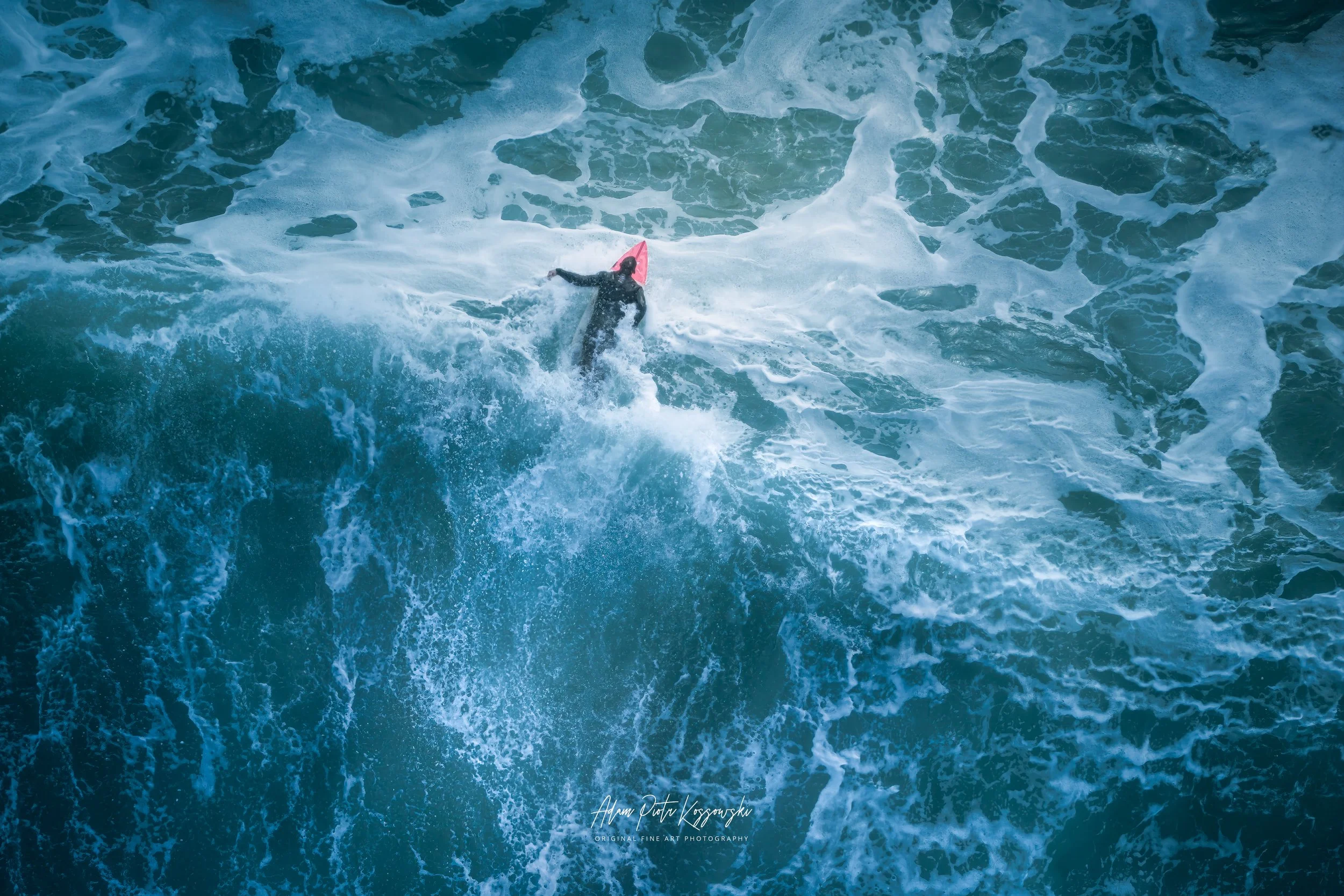
A pause at the tipping point—just before the ocean decides.
A single moment, suspended between force and stillness. There’s something compelling about the instant just before commitment, when a surfer holds back at the lip, the wave rising beneath, gathering shape and energy. This image, viewed from above, captures that fleeting threshold: one figure poised on the edge of motion, the sea beneath them sculpting its own momentum.
The photograph reveals a canvas of layered blue, from soft, marbled foam to darker, dense currents below. Late afternoon light spills across the surface, revealing both pattern and depth. The surfer, wearing a pink cap, adds a sharp visual anchor, set against a sea that seems intent on reminding one of its vastness.
This moment on the cusp is one of quiet intensity. The wave hasn’t yet broken, but its intent is clear. It is in the process of forming something, and the surfer reads it in real time—body angled, arms steady, waiting for the cue. No grand gesture. No spectacle. Just the subtle tension between readiness and restraint.
From this overhead view, the ocean takes on a new visual character. Its texture dominates the frame, turning the surface into something almost abstract. The sea reveals itself as both painter and subject: fluid brushwork in the foam, moody tones in the deeper blue, and a rhythm that never quite repeats itself. There is no calm, but there is clarity. And within that, a kind of peace.
Beyond its visual impact, the image speaks to a broader relationship with the sea, one not always defined by performance or mastery, but by immersion. For many who find connection in these waters, the appeal lies less in triumph and more in observation. The ocean, especially in the colder months, draws a certain solitude. Time spent drifting beneath the surface, following fish, watching the dance of kelp or the path of an octopus, becomes a way of engaging with the world at a quieter level.
This story belongs not just to the wave or the surfer, but to those quiet practices of noticing. The small movements. The hidden life. The slow understanding that builds through attention. There is something deeply humbling in that kind of experience—an awareness shaped by the sea’s rhythm rather than any human clock.
Seen through this lens, The Cusp becomes less about action and more about presence. A visual record of the threshold between moments, where the outcome is unknown and the value lies in the suspension itself. It mirrors those turning points found across life—unspoken, undefined, full of potential yet held in stillness. It’s not about what happens next, but about what is held in that breath before the break.
The image’s composition reinforces this narrative. The scale of the wave, the direction of motion, the relative smallness of the human figure. And yet, it never feels overwhelming. The colour palette is meditative rather than wild. The light is diffused, softening contrast, allowing detail to emerge slowly. This is winter light, familiar along southern coasts—a kind of indirect illumination that invites reflection.
Even the uncertainty of the moment becomes part of the image’s strength. There’s no clue whether the surfer takes off or lets the wave pass. The story remains open-ended. And in that openness lies an authenticity, a true to the way the ocean works, and true to how it is often experienced: not in neat conclusions, but in moments that linger such as seal wreck II.
The Cusp captures that feeling precisely. It documents more than a sport or a scene: it reveals a mindset. One shaped by stillness, by watching, by learning how to move with, rather than against, the elements.
And just like that, the moment passed—leaving only the rhythm of water, always returning to itself.