Circle of Life III
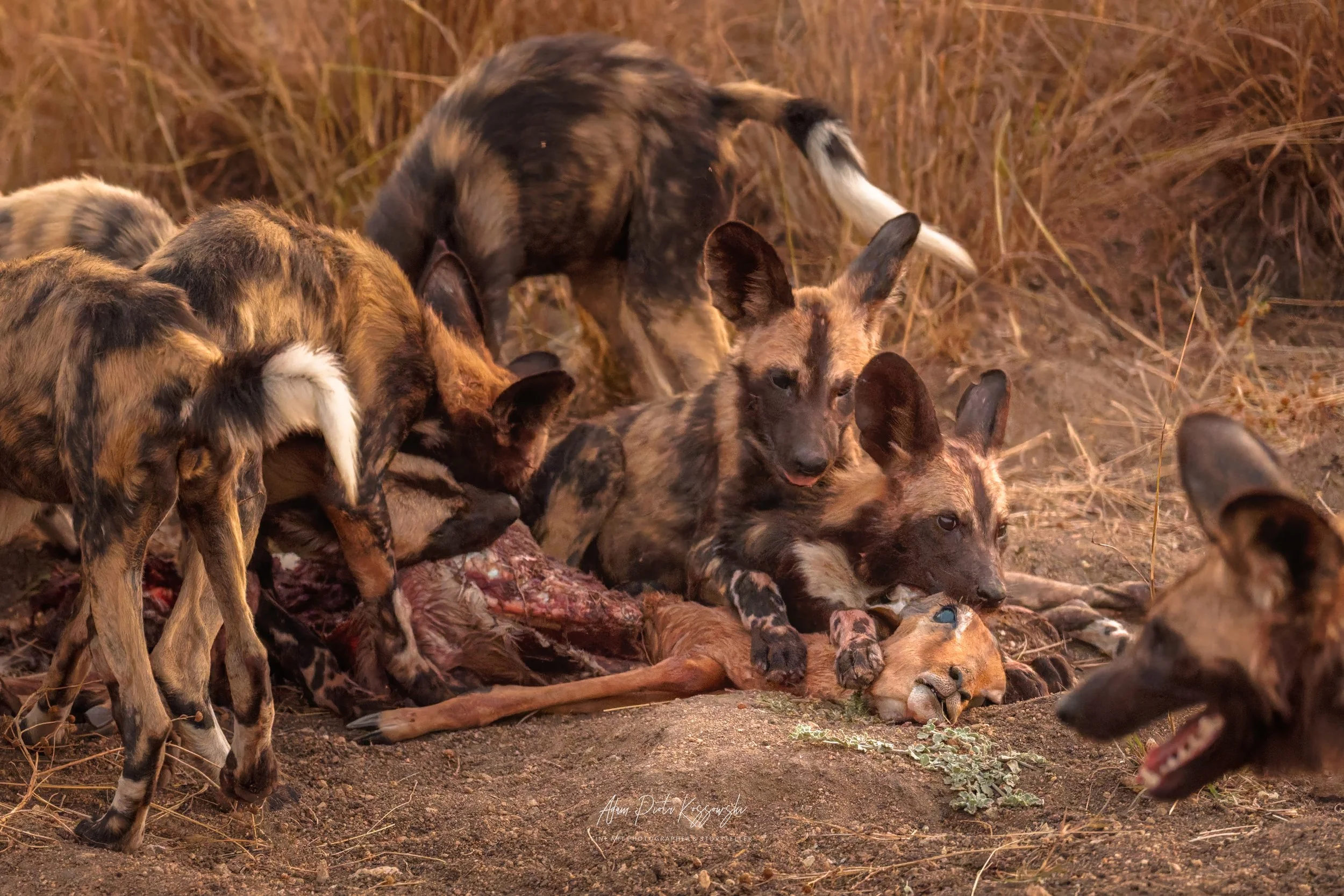
Younger African wild dogs feed after a successful hunt in Sabi Sand while adults remain positioned around the pack at dusk. Photograph by Adam Piotr Kossowski
At dusk in Sabi Sand, a wild dog pack gathered around a kill while the adults guarded the edges and the younger animals fed.
One of the young wild dogs had planted its forepaws across the antelope’s neck. Another pressed in beside it, its muzzle darkened from feeding. Around them, brindled coats shifted through the dry grass—black, rust, cream and white catching the last warmth of the evening light.
The antelope’s eye was still open.
We had followed the chase from the vehicle. The pack moved quickly through the winter bush, flowing around obstacles and closing the distance until the antelope was brought down. There was no ceremonial pause between pursuit and feeding. The chase ended, the pack gathered and the business of survival continued.
By the time we stopped, perhaps ten or fifteen metres away, sunset had already begun to drain from the sky. The air was unusually still. No wind moved through the grass, and beyond the occasional squeak, whine or clipped bark from the pack, the bush seemed to have withdrawn into silence.
We remained there for about an hour and a half.
There may have been thirty or forty wild dogs in the pack, with perhaps twenty younger animals among them. It was one of the largest and healthiest-looking groups I had encountered. Yet they were not all crowded around the antelope.
The younger dogs were feeding.
The adults had spread themselves around the area. Some stood farther out in the grass. Others watched from slightly higher ground, their large ears turning independently towards sounds we could not hear. Their attention moved between the feeding site and the surrounding bush.
They appeared to be acting as sentries.
From the vehicle, the arrangement was striking. The intensity of the kill occupied the centre, but the pack’s attention extended well beyond it. Even while the younger animals tore at the carcass, protection continued around them.
African wild dogs are intensely social animals, and pups are generally given priority when a pack feeds. What can look chaotic from a distance is often held together by close relationships, communication and cooperation.
That structure became clearer the longer we watched.
Whenever one of the adults moved towards the remains, a younger female would sometimes approach with her body lowered, offering the submissive movements common within the pack. The interaction appeared to divert the adult, allowing the others a little more time to eat.
Our guide watched her closely. He suggested that she might eventually become an important female within a pack of her own.
It was an intriguing possibility, although no future rank could be known from one evening. What could be seen was her awareness of the animals around her. Her behaviour was not confined to securing another mouthful for herself; it altered the movement of the group.
The sounds were softer than I might have expected.
There was feeding—the pull and tear of flesh, jaws working against bone—but very little aggression. Occasionally a high squeak travelled through the pack, followed by a brief bark or whimper. Their calls have a peculiar quality: thin, almost birdlike sounds emerging from animals built for speed and endurance.
The photograph holds only one compressed fraction of that evening.
The young dogs fill most of the frame, bodies overlapping and ears rising above the kill. One animal looks directly towards the vehicle while another keeps its jaws against the antelope. A white-tipped tail cuts through the darker coats. At the edge of the image, an adult passes close enough to become a blurred presence, still alert to whatever might be moving beyond us.
It is an uncomfortable scene because death is visible and immediate. The antelope had been running only minutes earlier.
Yet the wild dogs were not killing for spectacle, anger or cruelty. They were feeding. For them, the antelope represented survival: strength for the younger animals, sustenance for the adults and another day for the pack.
That does not make the sight pleasant. It simply places it within the life of the bush, where one animal’s ending is bound to another’s continuation.
This photograph became the third in my Circle of Life series (see Circle of Life II) because it carried more than the physical drama of the kill. The image also showed the social organisation around it—the young animals feeding, the adults holding their positions and the pack functioning as something larger than any one dog.
A pack under pressure
Sabi Sand Nature Reserve forms part of the open Greater Kruger ecosystem. The fences separating it from the adjacent Kruger National Park were removed in 1993, allowing animals to move across a much larger connected landscape.
For African wild dogs, space matters.
A large pack can create an impression of abundance, but sightings such as this are increasingly precious. The African wild dog, Lycaon pictus, is listed as Endangered. Even a pack of this size should not be mistaken for abundance as their population continues to decline across much of their range. Fragmented habitat, conflict with people, infectious disease, snares and road deaths place particular pressure on an animal that must travel widely and live as part of a functioning pack.
The strength of the pack before us depended on more than the success of one hunt. It depended on connected land, healthy prey populations and enough security for its younger members to survive, disperse and perhaps form packs of their own.
As the light faded, the younger dogs eventually moved away from the remains. Their earlier urgency gave way to play. They chased one another through the grass, submitted, circled back and broke away again, full of sudden energy after feeding.
Only then did the adults begin to come in more freely.
Some fed. Others continued watching the edges.
Night gathered quickly. The last detail left the grass, the dogs began to spread out and, almost as abruptly as the chase had begun, the pack moved off. Their patterned coats dissolved into the darkened bush until there was no longer anything to follow.
The antelope remained behind.
The wild dogs were gone.
Supporting African wild dog conservation
African wild dogs survive through connected landscapes, close monitoring and the protection of functioning packs. Readers wishing to learn more can explore the work of Wildlife ACT, which undertakes field monitoring, tracking, emergency response and population management in South Africa.
The African Wildlife Conservation Fund’s Lowveld Wild Dog Project monitors and protects wild dog populations in Zimbabwe’s Savé Valley Conservancy and Gonarezhou National Park. It also offers a direct pack-adoption programme.