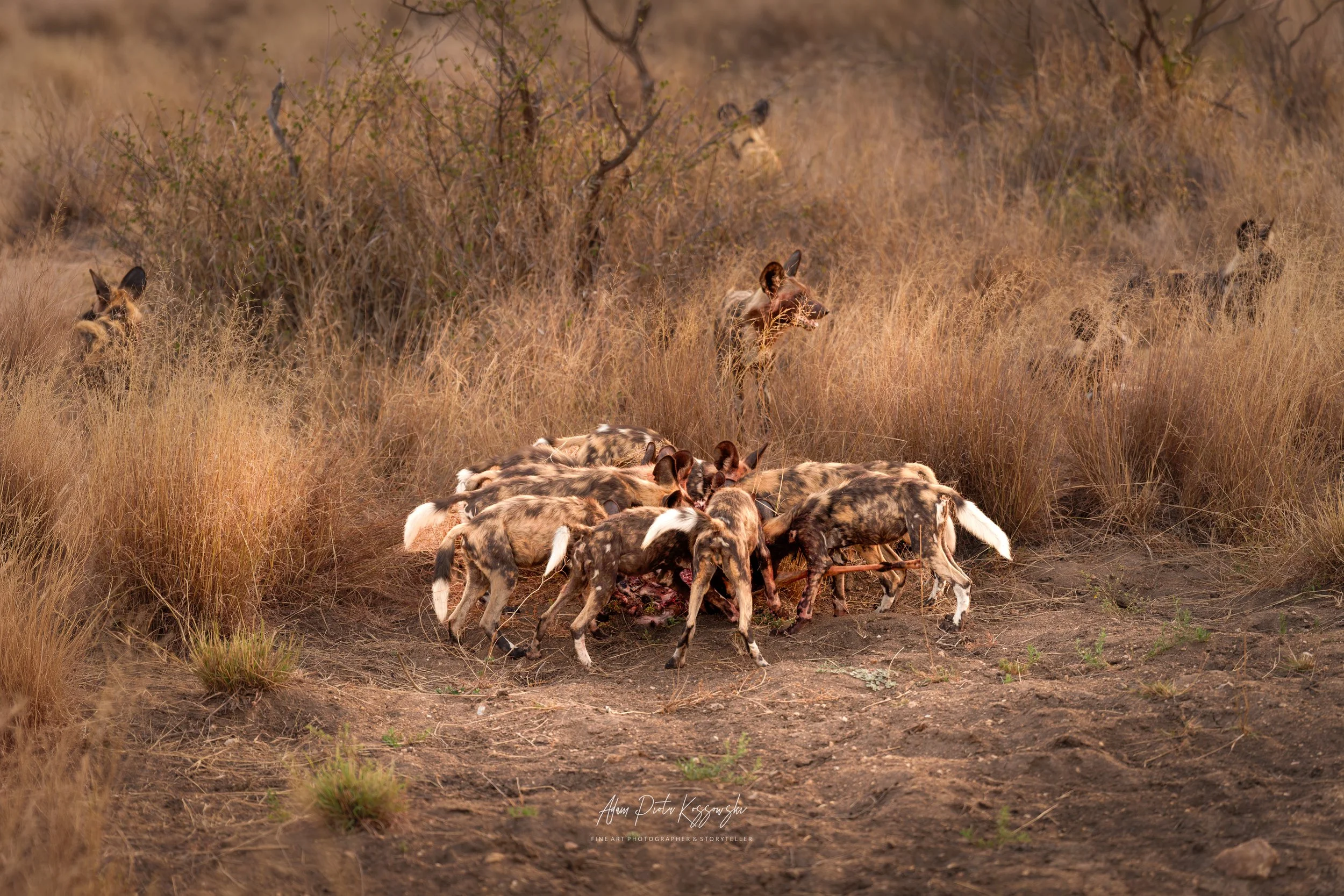
At dusk, the pack closes around survival.
The light was already leaving the bush when the wild dogs came together around the impala. They came with the urgency of animals that live close to the edge of hunger. The chase had been fast and broken, a flicker of movement through the Sabi Sabi grass, the kind of pursuit that leaves little time for thought. One moment there was a deafening stillness in the late Kruger heat, that heavy humidity that seems to hold every smell close to the ground. Then came the sudden scatter, the braking calls, the low rush of bodies through dry stems, and then the brief, terrible precision of the hunt.
By the time the camera settled on the scene, the sun was slipping into deep dusk. The grass had turned copper and straw, each stem catching a last thin blade of light. Dust lay low over the earth. The impala was already disappearing in the circle of hunger, not as it was, but as food, as sustenance, as the next few hours of life for a family that had spent each day waiting for this chance. Around the carcass, the younger dogs pressed in tightly. Their painted coats merged and separated in the grass, each animal marked differently, as if the bush had brushed them in ochre, black, white and gold. Tails lifted. Ears pricked. Bodies moving with restless, almost electric concentration.
I noticed the order of it. Some of the adults were not eating. They stood apart in the grass, heads raised, ears turning and twitching. One watched from the left, half hidden behind the tawny stems. Another stood behind the feeding circle, alert and still, its face partly veiled by the bush. To the right, darker shapes waited and scanned. A few had taken position on a slight rise further along, looking outward rather than inward, watching the horizon for hyena, lion, leopard, or any other danger that might be drawn by blood, the sounds of their feast or by pure chance. The youngsters were given their moment at the centre to feed, and the adults kept the edge to protect.
This is one of the reasons African wild dogs hold such a unique place in the animal kingdom. They are efficient hunters capable of running prey down through stamina, coordination and speed. But they are also among the most socially organised carnivores in Africa. Their lives depend on the pack. Pups are raised not only by their parents, but by the entire group. Adults hunt, guard, feed and protect in ways that make the family more important than the individual. Recent field observations and research have described how young wild dogs can be given priority at kills, a striking contrast to many other large carnivores, such as lions, where age, size and dominance decide who feeds first. That can be seen here as the young ones feed in the middle, heads down, legs braced, their narrow bodies working close together while around them, the adults provide the protection.
African wild dogs, also known as painted dogs or painted wolves, are among the continent’s most endangered carnivores. The IUCN lists them as Endangered, with the species under pressure from habitat fragmentation, conflict with people, road mortality, disease and competition with larger predators. Estimates often place the remaining wild population at fewer than 7,000 individuals across fragmented parts of sub-Saharan Africa. That scarcity gives every sighting a particular weight. To see one is memorable. To see a pack in motion is rare privilege. To see the social structure of the pack revealed at a kill, in the last light of day, is to be reminded that survival is not only a matter of strength. It is a matter of cooperation for survival.
The feeding continued quickly. Wild dogs cannot linger casually over a kill in the way lions sometimes do. They are lighter and more exposed to losing what they have won. Hyenas can quickly arrive and lions may kill wild dogs if they encounter them. Even a successful hunt does not guarantee a full meal for every member of the pack. So the dogs feed with speed, but not chaos. This is the hard story of the bush, and there is no softening it without losing the truth of the place and the experience. The image does not make the moment gentle. It does something more honest for me: it shows the circle of life at work where one life ends, allowing others to continue.
Eventually the last light thinned. What had been gold became brown, and then shifted quickly to darkness. The white tips of tails caught the eye for a little longer, then began to lose their brightness. The dogs’ calls rose and fell, sometimes close, sometimes strangely distant, as if the sound moved ahead of them into the evening. The carcass became less visible. The bodies shifted over it as seconds mattered. Meat vanished and the pack’s focus remained absolute. And so as dusk settled over Sabi Sabi, the bush seemed to close around them again. The sound of feeding softened into the coming night. The sentries remained alert on the rise. The last of the light slipped from the grass. What had happened in the open would soon belong to the night, leaving only the memory of painted bodies gathered tightly around life’s oldest exchange.
Photographer’s Note
This photograph was taken at Sabi Sabi in the Greater Kruger region during an authentic wild dog sighting at dusk. The image records a real moment after the pack had hunted down an impala, with younger dogs feeding while adults watched from the surrounding grass and higher ground. The intention of the image is to show not only the drama of the hunt, but the social structure of the pack and the raw, unedited rhythm of survival in the African bush.
For all their speed and hunting success, wild dogs live precariously. Their need for wide ranges brings them into contact with roads, fences, livestock areas and domestic dogs. Diseases such as rabies and canine distemper can move quickly through packs. Conservation work often has to focus not only on protected areas, but on corridors, coexistence, monitoring and reducing conflict across landscapes where animals do not recognise human boundaries. In places like the Greater Kruger region, where reserves form part of a larger conservation network, such sightings carry another layer of meaning. They are not only moments of drama. They are signs of a living system still holding together.
Photographer’s Camera Settings
This image was photographed with a Sony A1 using the Sony FE 70-200mm f/2.8 GM OSS II lens at a focal length of 132mm. The exposure was set at 1/500s, f/2.8, ISO 1250. The wide aperture helped hold the focus on the wild dog pack in the fading dusk light, while the shutter speed allowed for the movement and urgency of the feeding scene to be captured clearly.
About The Raw Africa Collection
The Raw Africa Collection is a series of fine art wildlife photographs capturing the untamed beauty, power, and diversity of Africa’s animal kingdom. Each image tells a story — moments of stillness, bursts of movement, and the raw essence of life in the wild.