Where summer begins in salt and light
In Arniston, summer does not always arrive with warmth. Some mornings begin with a clean, unexpected freshness, especially if you come to the coast expecting only heat, bright sand, and an easy blue horizon. This was one of those mornings. It was December in South Africa, yet the day opened with a crisp edge. A shifting wind had moved through before sunrise, carrying a faint chill and turning the sea against the incoming tide. By the time I reached the short cliff shoreline near the landing, the water already looked changed, darker in places, restless, and full of cross movement beneath the first light.
I was out early to photograph Arniston as it wakes. That hour matters in a village like this. There are no real crowds to wait out here, no sense of needing to escape the rush before it arrives. Arniston remains small in scale and quiet in character, which is part of what gives it its hold on people who come looking for places that still feel unforced. The stillness is real, but so is the working life behind it.
By then, the fishermen had already gone out. What sits at the shoreline here is not a formal harbour in the usual sense, but a landing, practical and exposed, shaped by the habits of a fishing community that has worked with this coast for generations. Boats are launched from the slipway and brought back out of the water again rather than lying sheltered in a marina style harbour. That physical reality changes the feeling of the place. It makes the sea seem closer, more immediate, and less arranged for comfort. The wider Arniston and Waenhuiskrans area is still closely tied to its fishing heritage, especially around Kassiesbaai, the historic fishing village beside the landing.
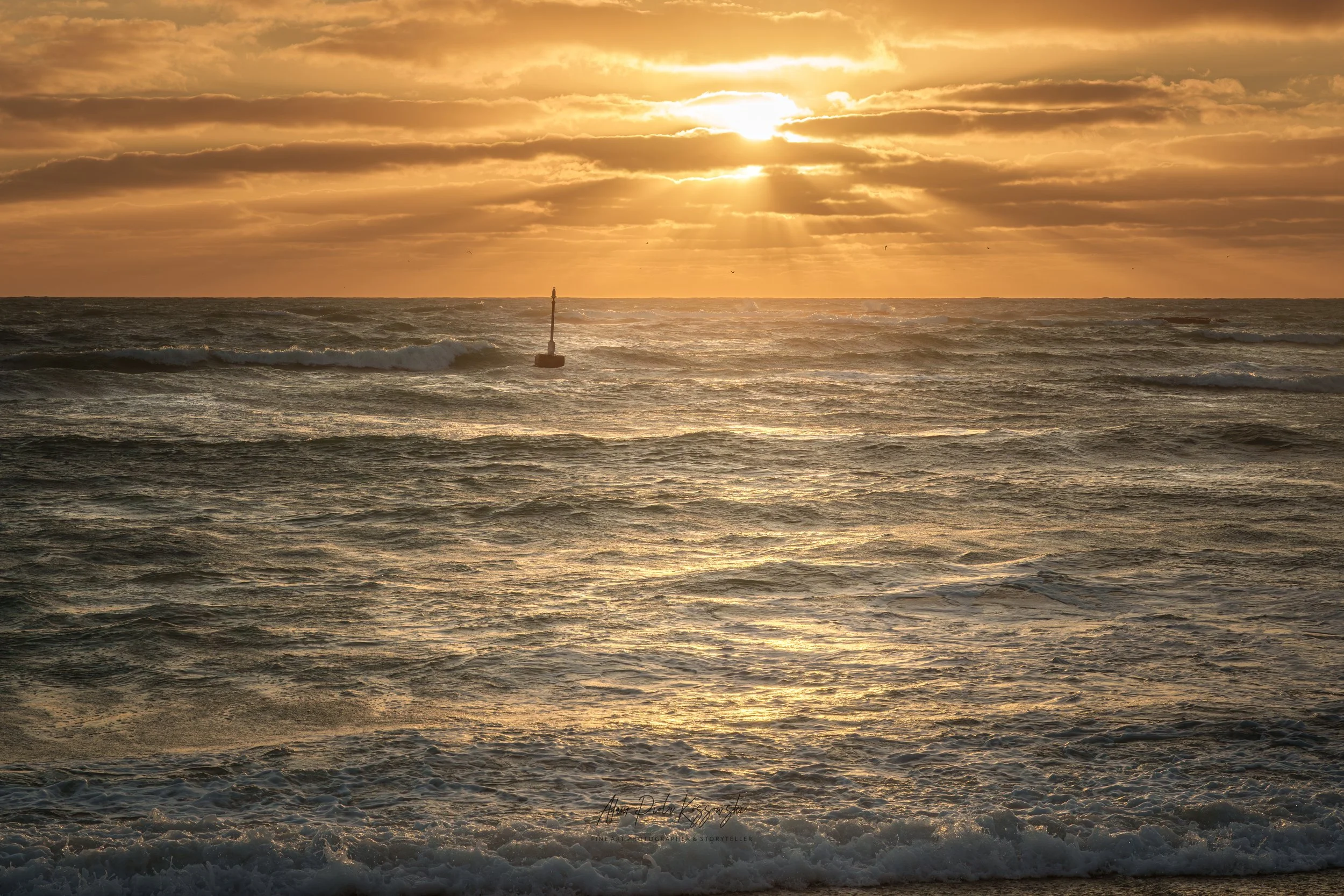
From where I stood, the entrance beacon held its place offshore, small but steady against a sea that was far from calm. The breeze pressed hard enough to roughen the surface and break the incoming sets into uneven lines. Nothing about it felt staged or decorative. This was not the postcard version of a summer coast. It was a living edge of shoreline, shaped by wind, tide, labour, and timing. Then the sun rose higher behind a bank of cloud and the whole horizon changed. Gold began to spill through the breaks, not softly, but in shafts. Light struck the water in long bands and the surface answered in bronze, amber, and steel.
That contrast was what held me there. The sky carried warmth. The sea still carried the mood of the wind. The air on my skin remained cool while the morning in front of me burned with colour. Arniston often works that way. Its beauty is immediate, but its character reveals itself more slowly. You notice it in the shifts. In the way weather can sharpen the shoreline. In the way the light can make the coast feel open and intimate at the same time.
For a traveller, this is one of the best times to understand where you are. Not later, when the day has fully opened, but early, when the landing still feels practical and the light moves faster than people do. You begin to see that Arniston is not simply a pretty stop along the southern Cape. It is a small seaside settlement with a strong sense of place, known not only for its coast but also for the heritage of Kassiesbaai and the cave that gave Waenhuiskrans its older name.
What I remember most clearly is the feeling of pausing before making my way down toward the small beach next to the landing. The scene in front of me seemed to hold the village in suspension. Behind me, the day would come. Ahead of me, the sea kept moving under a sky that had already turned generous with light. In that moment, Arniston felt both exposed and sheltered, remote yet inhabited, quiet but never empty.
That is often the difference between passing through a place and actually experiencing it. A quick stop shows you its surface. A quiet morning reveals its structure. Here, it was in the sequence of things: the cold edge in the air, the fishermen already gone, the turned sea, the beacon holding its place, the first gold arriving over water that had not yet softened. These details are small, but together they make the memory feel real.
For anyone drawn to places that still hold onto their own rhythm, Arniston offers something rarer than spectacle. It offers atmosphere. It rewards patience. It asks very little of you beyond attention. And once you have stood there in the first light, with the wind still carrying the last of the night and the landing already behind the day’s work, it becomes easier to understand why this coast stays with people.
That morning, I had set out to document Arniston waking up. What I found instead was a reminder that some places do not need to shout to be memorable. They work more quietly than that. Through weather, timing, working routines, and light. Through the way the sea turns under a change in wind. Through the way a small place can still feel deeply complete.
You see some of that same quiet character again in Slow Time: A Midday Pause in Arniston Village, where the village reveals itself differently once the day has fully settled. And for readers discovering the area for the first time, the broader cultural and coastal context of Arniston/Waenhuiskrans helps explain why this small settlement leaves such a lasting impression.
Photographer’s Note
This photograph was made in Arniston, Western Cape, South Africa, during a summer morning in December while documenting the village at first light near the landing. The scene is authentic and observed, with the entrance beacon, sea conditions, and sunrise recorded as they appeared at that moment. It is a single frame and not a composite. Photographed on a Sony A1 with a Sigma 24 to 70mm DG DN Art lens at 70mm, 1/640 sec, f/11, ISO 80. The intention was to capture the meeting point between the crispness of an early wind-shifted morning and the warmth of the first summer light over the sea.
About The Arniston Stories
The Arniston Stories is a photographic series capturing the quiet resilience, heritage, and rhythms of life in the coastal village of Arniston (Waenhuiskrans), South Africa. Through a collection of fine art images and accompanying narratives, the series offers a window into the textures, histories, and natural beauty of this unique place, told one story, one photograph at a time.