Closing Light
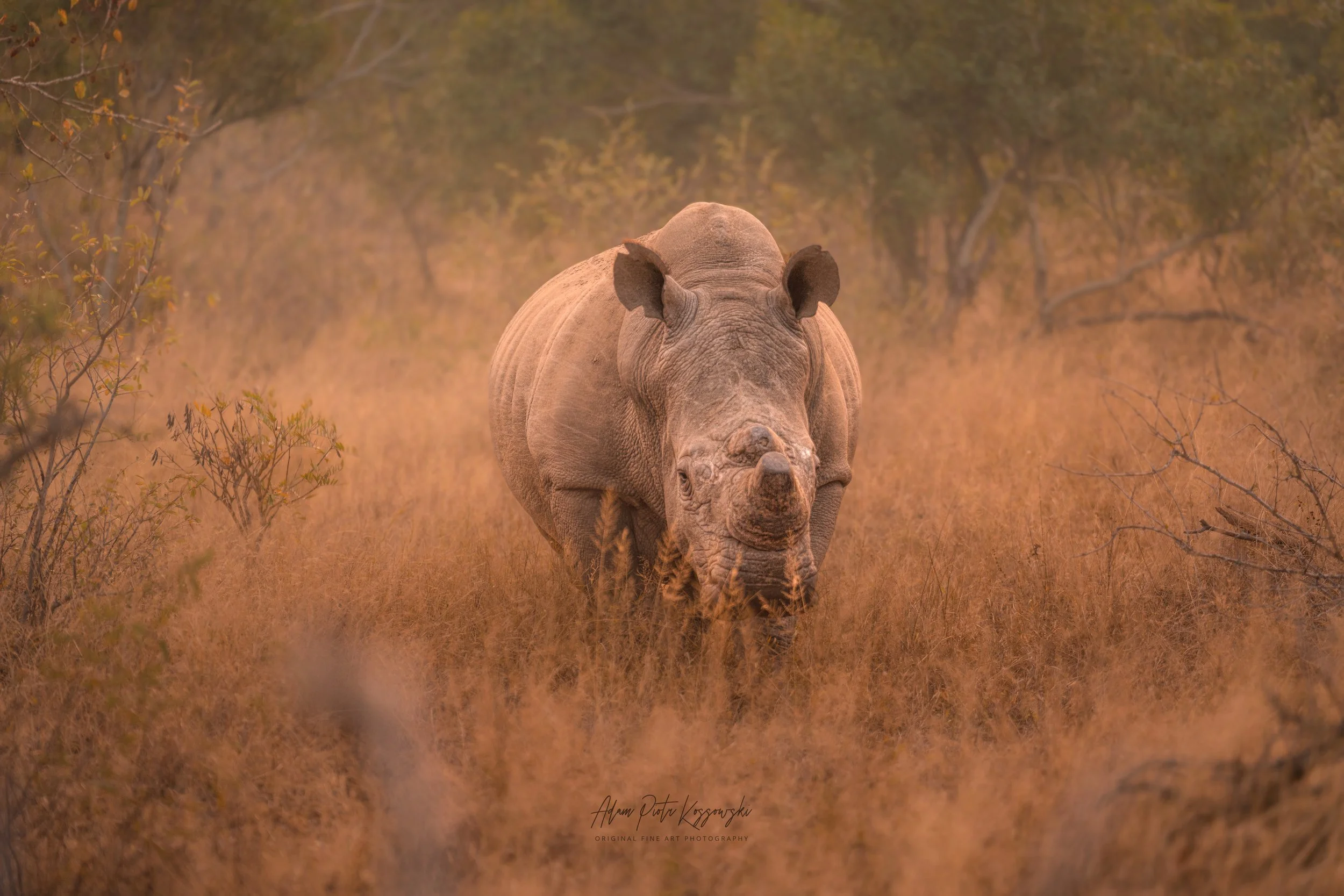
As the day exhales, a solitary presence moves through the last warmth of the veld.
The light is already thinning when we first see him, the afternoon loosening its hold on the land as shadows lengthen across the grass. Dust hangs low and warm, turning the air the colour of copper. Somewhere behind us, the day is beginning to close itself, but here the world feels held, suspended in a quieter hour. He stands alone at the base of a gentle rise, a broad, compact shape moving with unhurried certainty through the veld.
A lone black rhino bull. Dehorned. Massive and deliberate, yet calm in a way that feels earned rather than accidental. Each step presses into the dry grass, parting it softly, his weight absorbed by the land as though it recognises him. The sound of his movement is minimal, a low rustle, the brush of hide against stems. There is no rush in him. No alarm. Only the steady business of being.
We follow at a respectful distance, allowing the space to remain his. Time stretches differently in moments like this. Minutes feel longer. Observation becomes the only task that matters. He lowers his head to feed, moving from bush to bush with a selective patience that speaks of familiarity and instinct. Black rhinos are browsers, drawn to shrubs and low-growing plants rather than open grass, and here he pauses repeatedly at one particular patch.
Tiny blue flowers, scattered low among the stems, almost invisible unless you know to look. He noses into them gently, lips working with surprising precision. It is not frantic feeding, but careful. Considered. The kind of detail that would be missed entirely if you were in a hurry.
Our guide, Herman, watches closely. When the rhino moves on, he steps forward to examine the plant, crouching low to collect a small sample. The information will be passed on to researchers studying black rhino behaviour and diet. Even in stillness, knowledge is being gathered. Even in quiet moments, conservation is happening not through force, but through attention.
The light continues to soften, drawing warmth out of the grasses and settling it on the rhino’s thick, folded skin. Dust rises gently around his legs, catching the sun and glowing briefly before drifting away. The dehorning is visible, unmistakable, yet it does not diminish his presence. If anything, it sharpens it. A reminder of what has been taken, and what is being fiercely protected.
He begins to move uphill, reaching the curved edge of the rise. From where I stand, the hill forms a subtle crescent behind him, framing his body against a fading wash of gold and muted green. For a moment, he pauses there, outlined by light that seems to come not from the sun itself, but from the land reflecting it back.
Then he turns.
Not abruptly. Not with intent. Just enough to shift his path. He ambles towards us, closing the distance slowly, the rhythm of his walk steady and unthreatened. I remain still, aware of my breathing, of the camera resting lightly in my hands. This is not a moment to interrupt. Only to receive.
As he approaches, the textures become clearer. The cracked, ancient lines of his skin. The dust settled into every fold. The depth of his eye, dark and watchful without being wary. He is close enough now that the weight of him feels present, tangible, yet there is no sense of danger. Only awareness. Mutual acknowledgement without demand.
This is the closing light. Not the dramatic blaze of sunset, but the softer hour that follows. The time when the land exhales and creatures move with less urgency. The time when the day’s edges blur and everything feels briefly balanced between what has been and what will come.
I take the photograph as he moves through that light, allowing the moment to pass through me rather than trying to hold it. There is no need to chase perfection here. The scene is already complete. A solitary animal. A quiet hill. A day gently letting go.
When he eventually turns away, the dust settles again, and the veld returns to its low, rustling hush. The light fades further, becoming memory even as it still touches the land. We do not follow. Some moments ask only to be witnessed, not extended.
Long after he disappears into the bush, the impression remains. Not of size or power alone, but of resilience. Of survival shaped by patience, observation, and the collective effort of those who choose to watch closely, to learn, and to protect without spectacle.
The land darkens. The day closes. And somewhere beyond the hill, the black rhino continues on, carrying the quiet weight of his presence into the coming night.
Photographer’s Note
This photograph was taken in Balule, within the Greater Kruger National Park, South Africa. The image captures a lone male black rhino that had been dehorned as part of ongoing conservation efforts. We observed the rhino over time as he browsed selectively among shrubs, including plants with small blue flowers that were later sampled by our guide for research purposes. The photograph is a single, authentic frame captured in late afternoon light as the rhino moved naturally through the landscape.
About The Raw Africa Collection
The Raw Africa Collection is a series of fine art wildlife photographs capturing the untamed beauty, power, and diversity of Africa’s animal kingdom. Each image tells a story — moments of stillness, bursts of movement, and the raw essence of life in the wild.